
What the Binder Can’t Tell You
When The Strong National Museum of Play received game designer Arnold Hendrick’s personal Magic: The Gathering collection from his estate, it acquired more than a set of published cards. The museum’s account describes a sleeved Chaos Orb and two hand-drawn versions among the associated cards. A checklist could help identify the published card, but it would never tell a researcher that Hendrick’s collection included those drawings alongside it. The museum account supplies that context and explains how the collection reached The Strong. It does not establish where Hendrick picked up his published Chaos Orb. A well-documented transfer can leave an earlier one entirely open.
That gap suggests three different sentences a collector might write about a single object. The first is an identification: “This copy matches the alternate-art printing shown in the publisher’s gallery.” The second concerns distribution: “The publisher lists this treatment as a fixed Bundle insert.” The third concerns custody: “This copy entered my collection in a trade with a named collector.” Each takes a different kind of evidence. Matching art can help identify a printing but cannot name a former owner. A contents guide can establish the publisher’s intended route without tracing a transaction. A trade record can identify the immediate source without saying anything about the original opening.
For a hypothetical identification-only sleeve label, consider “Dark Magician | RA04-EN106 | original acquisition unknown.” Suppose the catalog behind the label records the matched illustration and rarity as well as the printed code. The short label confidently names the printing family while staying silent about which box supplied the card or who opened it. If the binder distinguishes copies within that family, the illustration and rarity belong on the sleeve as well; if it is organized by code, they can stay in the catalog. The point is not to squeeze the full identification into the sleeve. It is to make sure what fits there does not overstate what has been established.
A hypothetical label with a documented distribution claim could read “Queen Kayla bin-Kroog | Bundle promo treatment | opening unrecorded.” Here the collector has matched the art and finish and checked the publisher’s contents guide. “Bundle promo treatment” names a documented way the version was supplied. “Opening unrecorded” keeps the label from implying that the collector has identified the particular Bundle that held this copy. That distinction matters when a card arrives loose. The printing can be well enough identified for a section devoted to fixed inserts even if the only documented transaction in its history is a recent trade.
For the same hypothetical card with a recorded handoff, the custody label could instead read “Queen Kayla bin-Kroog | received in trade, May 2025 | C-014.” The local number points to a catalog entry with the trade record and, if available, photographs linking that record to this specimen. The date is the collector’s acquisition date, not the card’s release date. The trade partner’s identity can remain in the private record. If that person remembers opening a Bundle but has no corresponding record, the catalog can preserve the recollection under their name without turning it into a confirmed opening.
The Smithsonian’s National Museum of American History offers a useful model for keeping these distinctions intact. Its registration policy distinguishes an object’s number and physical description from the method of acquisition, the source and the provenance. It also places supporting acquisition and collections documentation in the official registration file. That is a museum procedure, not a trading-card authentication or storage standard. What transfers to a binder is the division of work: a short identifier leads to a record that says what the object is, how it came in and what is known about its earlier history. The evidence can live behind the record rather than on the display label.
An unknown field does more work than a blank one. A blank can mean nobody asked, the answer was lost during a spreadsheet import, or the question did not apply. “Original acquisition unknown; trade documented” tells the next reader exactly where the evidence stops. It also prevents a common mistake when cataloging duplicates. Two copies can match the same printing and share a distribution description. If only one came with a dated note linking it to a named collector, carrying that history over to both would erase a real difference. Keep the printing description shared and the histories separate.
This changes how a binder can be organized without making it less useful. A checklist binder can accept a confidently identified card even when its chain of ownership is sparse. A binder intended to document one player’s tournament history may need a stronger link to that player before the same card qualifies. Neither decision requires a guess about the earliest transfer. In Hendrick’s case, the estate donation and the presence of the drawings are independently worth recording. An honest account can preserve both details and still leave the published card’s original acquisition unanswered.
Choose a Source That Can Answer the Question
Start a lookup by writing the claim you want to test, not just the name of the card. “This is the alternate-art version” calls for different evidence from “this was handed out at a particular store on Saturday.” Searching the name alone can turn up an official page that is accurate but answers neither question precisely. A more useful sequence starts with the specimen, moves to the publisher’s intended distribution, checks whether the named event or offer actually took place, and finally asks what ties the copy to a person or transaction. It is fine to finish the first two tasks without being able to finish the last two.
For the specimen, record what is visible before interpreting it: name, printed code, language, illustration, any stamp and the finish where the photograph allows it. A publisher image gallery is useful for comparing designs. Wizards of the Coast’s variant gallery for The Brothers’ War, for example, shows more than one image of Queen Kayla bin-Kroog. The name alone will not select the right one. A clear image can narrow the design match, but a flat or poorly lit photograph may not resolve the surface treatment. Note the detail still missing and ask for a photograph that shows it rather than letting a seller’s description settle the question.
Next look for a contents guide that answers how the matching version was supposed to reach collectors. Wizards lists the traditional foil alternate-art Queen Kayla bin-Kroog separately from the eight Set Boosters in the standard Bundle. That distinction answers a specific question: the listed promo is a fixed item in the outer product, not one of the cards the buyer had to find inside those eight boosters. The guide describes the configuration, not what survived in a secondhand box or where a photographed loose card came from. When using it, copy down the exact product name and the entry that supports the claim.
For a claim about a named event, look beyond the advertised terms. Bandai Namco Amusement America’s official-shop tournament notice specifies which Volume 1 pack was intended for participants and which was intended for the winner, and points players to a store calendar. That tells you what the shop advertised. Even a dated calendar entry is still evidence of scheduling, not proof that play occurred. A contemporaneous standings sheet or a store’s dated report of the completed tournament would answer a different question. Neither, on its own, would necessarily show that every listed prize was handed out.
An original receipt works at the transaction level. If it names the merchant, date and exact product variant, it can support a claim that the product was purchased there on that date. If it lists only a general merchandise category, the evidence is less specific. A receipt that does not name a promo cannot, by itself, show that the promo was handed over with the purchase. A dated opening record that connects the precise product and the card, or a transaction record that itemizes the card itself, can close more of that gap. A receipt for a later sale of the loose card can establish a later transfer without telling you anything about the opening.
Consider a hypothetical seller who supplies a clear Queen Kayla bin-Kroog photo and says the card was a Buy-a-Box reward. The photo matches the Bundle illustration, and the seller attaches a genuine Wizards announcement describing a Buy-a-Box offer during the same release window. That offer names Mishra’s Foundry. The announcement is relevant to the set and the period, but it is not evidence for the seller’s account of the Queen Kayla card. Record the visual match and check the Bundle contents guide for the version in question. Leave the seller’s Buy-a-Box story unverified rather than replacing it with a different unsupported story about the opening of this copy.
A compact worksheet can fit on a single catalog screen. Use the same prompts for each claim: “Claim to test: ___; exact source and entry: ___; observation or statement it supports: ___; what it does not establish: ___; next evidence needed: ___.” Make one line for the printing, one for intended distribution, one for the particular event if claimed, and one for the copy’s transfer. For the hypothetical Queen Kayla, the last field on the printing line might be “oblique photo to confirm finish.” On the transfer line it might be “dated opening record that links this specimen to the product.” Those requests are not interchangeable.
The worksheet also helps decide when a lookup is finished for the purpose at hand. If you are building a binder of alternate illustrations, you may only need enough visual evidence to distinguish the designs. If you are documenting a store’s release weekend, a matching card and the right publisher guide are a start, but a dated record from the store will carry more weight for the event itself. A receipt matters most when the claim concerns a transaction, and then only to the extent that its details match. Keeping a separate line for each claim means a strong source can do its full job without quietly being asked to do another.
Pokémon 151: The Box Is Not the Expansion
The English Pokémon TCG: Scarlet & Violet 151 Ultra-Premium Collection puts the expansion name on a product that contains more than expansion cards. The Pokémon Company International announced the collection for October 6, 2023, in its North American campaign materials. Its contents description lists 16 Scarlet & Violet 151 booster packs and separately names a Mew ex promo, a Mewtwo promo and a metal Mew ex card. Those are two layers of the same product: the boosters, which contain cards drawn from the expansion, and the named items included outside them. The distinction is easy to lose once the box is discarded and all the cards are filed together.
The expansion checklist answers a narrower question. In the English list, Mewtwo appears at number 150 and Mew ex at numbers 151, 193 and 205. The checklist also uses separate indicators for finish and rarity. A collector can use the number to look up the corresponding entry, then read the legend rather than assuming a finish indicator is a rarity symbol. But the checklist is not a manifest for every product with the expansion’s branding. The appearance of three Mew ex numbers on it does not identify the separately listed promo or the metal card by name alone, and it does not tell you which cards the 16 packs in an individual box contained.
Use the product announcement and expansion checklist side by side rather than trying to make either do both jobs. For a box inventory, make one line for the 16 boosters and separate lines for the Mew ex promo, Mewtwo promo and metal Mew ex. For an expansion inventory, use the numbered checklist entries. In the first record, the distinction between a pack and a fixed inclusion is central. In the second, the question is whether the card in front of you matches a numbered expansion entry. A collection can maintain both inventories without treating every boxed extra as a missing slot in the expansion.
Suppose a loose English Mew ex comes in with a clear front photograph. Its printed number reads 151 and the visible details agree with the expansion entry. The seller says, “From the Ultra-Premium Collection,” but supplies no wrapper, opening photographs or product record. A reasonable hypothetical catalog note is: “Mew ex, no. 151; English expansion checklist match. Seller attributes copy to Ultra-Premium Collection; no evidence of immediate container.” If the statement were true, it could refer to a booster in the box rather than to a fixed insert. The checklist match does not validate either reading of the seller’s description.
Now suppose the same seller adds a photo of the empty box. It makes the story more specific but does not tie the loose card to a pack or a fixed slot. A contemporaneous opening record that actually shows the card being removed from one of the boosters would support the immediate-container claim. If the sequence also links that booster to the outer box, both layers can be recorded. By contrast, to classify a card with incomplete photos as a metal box inclusion, seek views that help establish the object’s construction as well as its printed design. A front image and a familiar name cannot establish material. The product announcement says a metal card belongs in the intended configuration; it cannot tell you that the photographed specimen is that card.
The exact eBay listing titled “Pokémon Scarlet & Violet 151 Ultra-Premium Collection Box Mew English” is an example of how to match the outer packaging and the edition described by a seller. Its listing photos show the white Mew packaging, and the description identifies the English Ultra-Premium Collection. Those details help distinguish the advertised outer product from a listing for loose 151 boosters or a single Mew ex. They do not verify the seal, authenticate the photographed box or establish that its contents match the publisher’s announcement. The listing is useful for recognizing the packaging and the seller’s edition label, not for deciding what is inside or assigning a value.
The record can be short if each observation sits in the right field. In the hypothetical loose-card intake, enter “151” under printed number, “English” under language and the expansion checklist entry under identification. Describe the finish separately if the available view supports it; if it does not, say so. Put the Ultra-Premium Collection story under seller attribution, with immediate pack and outer product still unconfirmed. If a linked opening record appears later, update those container fields without changing the card number or treating the original uncertainty as a mistake. If all that turns up is a product receipt, record the purchase evidence without promoting it to an opening record.
A checklist-defined binder can therefore accept that hypothetical Mew ex in its numbered slot without crediting it as a box insert. A display about the Ultra-Premium Collection has a different organizing question: which objects represent the sealed boosters and which represent the named cards included beside them? For that display, a Mew ex pulled from a booster can illustrate what a pack supplied, but it should not stand in for the fixed Mew ex promo or the metal card. Labeling the two layers makes the display useful even when the original box is gone.
The Pokémon Checklist That Sits Beside the Checklist
The English Scarlet & Violet 151 expansion checklist and the Pokémon TCG Prize Pack Series Five checklist can both lead you to Mew ex. They do so for different reasons. The expansion list puts Mew ex at number 151, among its other entries for the card. The prize list includes Mew ex as MEW 151 and Dodrio as MEW 085, alongside cards carrying identifiers from other expansions. Those identifiers are not positions in a new expansion called Series Five. They point back to expansion entries while the prize checklist answers a separate question: which cards Pokémon lists for this organized-play pack series.
That difference matters when you transcribe the bottom of a loose card. In a hypothetical Mew ex intake, copy the set marking and collector number as they appear on the specimen, including any leading zero or denominator that is visible. Put the publisher’s reference, MEW 151, in a lookup field rather than using it to replace the transcription. In a separate field, describe the observed finish; in another, record Prize Pack Series Five as a documented pack family for the listed entry. If you cannot assess the finish from the supplied image, enter “not assessed” rather than “standard.” A flat photograph and a positive identification of a standard finish are not the same observation.
Read each checklist’s legend on its own terms. The English expansion checklist separates finish indicators from rarity symbols. The Series Five checklist distinguishes “standard set” from “standard set foil” and marks both Dodrio MEW 085 and Mew ex MEW 151 only as foil. If glare conceals the surface of a photographed Dodrio, the identifier still gets you to the right entry, but the copy’s finish remains unassessed. Ask for a clear view of the printed details and an angled view of the surface. Those views can improve the description of the object; they cannot document its removal from a particular pack.
Imagine auditing a loose Mew ex acquired in a trade. The new owner has a front and back photograph and a message from the trader saying it was a Series Five pull. The expansion checklist supports the identification at number 151. The Series Five checklist adds that Pokémon lists Mew ex MEW 151 for that pack family. Neither list verifies the trader’s account. The useful record has three distinct lines: “Expansion reference: Mew ex, 151”; “Announced distribution reference: Prize Pack Series Five lists MEW 151”; and “Copy history: trader reports a Series Five opening; no linked opening record supplied.” Add the observed finish where the photos support it. There is no need to delete the trader’s account or adopt it as fact.
For the printing, check the front for the Play! Pokémon logo. Pokémon says Series Five cards carry it, so an unobstructed photo can help distinguish a Prize Pack version from the ordinary expansion printing. The logo is not unique to Series Five and does not document a particular opening. For that claim, look for contemporaneous photos or video that identify the wrapper as Series Five and show this card coming out. If the record comes from a previous owner, a linked trade record helps connect the card shown then with the card in hand now. A detached wrapper or League attendance record alone does not make that connection.
The same caution applies when using the checklist to decide what to look for. Finding both Mew ex and Dodrio on the Series Five list does not say they appeared together in a pack or were equally likely pulls. The standard and foil distinctions are useful for searching and sorting, not for estimating how many of each finish were made. If a seller uses the prize list to argue that a copy is scarce, the list has been asked to supply a number it does not contain. The supported statement is about eligibility for the pack series, not frequency or surviving population.
An expansion binder can use the English expansion checklist as its rule for which numbered slots exist, with a separate policy for which finishes to collect. That gives the hypothetical Mew ex a place once it meets the identification criteria, without requiring the owner to resolve the trade story. A binder that also documents organized play can add a Series Five page keyed to that checklist. Its owner might accept an identified version for display but require copy-specific evidence before labeling it “opened from Series Five.” If all that is known for a second MEW 151 is an expansion match and an uncorroborated account, the owner can leave the Series Five specimen slot open or display the card with the uncertainty visible. The expansion number stays the same in either binder; the difference is what the slot claims.
The Pokémon Art Contest Was Not the Distribution Event
On September 23, 2024, The Pokémon Company International and Creatures announced that submissions by Kazuki Minami, Acorviart and Anderson had been selected to appear on promo cards. For a collector tracing one of those illustrations, that announcement explains why the artwork was chosen. It does not say that collectors received the cards that day, identify the stores that would hand them out or supply a release date for the promos. In a catalog, September 23 belongs beside the contest result. Putting it in an acquisition or distribution field would turn a dated decision about artwork into a dated claim about physical cards.
The next useful document is Pokémon’s North American announcement for Pokémon Day 2025. It names the contest promos among the giveaways at participating Pokémon League celebrations. It also describes a gift-with-purchase route through participating retailers, including Pokémon Center, beginning February 21, 2025, while supplies lasted. The participating League celebration and the qualifying retail transaction are distinct routes. The February 21 start applies to the announced retailer offer; it is not a date to attach automatically to a League copy. The retailer’s purchase condition likewise is not evidence that a purchase was required at a League celebration. For a copy claimed to come from another market, look for that market’s announcement rather than importing the North American terms.
The words “participating” and “while supplies lasted” matter when you move from campaign history to a particular shop. The announcement establishes that the retailer route was planned and gives its start date. It does not show that every shop took part, that a participating shop still had the cards at a particular hour or that a qualifying customer actually received one. A store notice can put a named location on the map, but a notice advertising the offer still only establishes what was advertised. Evidence for an individual handoff has to narrow the account further.
Suppose a family has two loose copies with the same contest illustration. For the first, they have a retailer receipt dated after the announced start. In this hypothetical example, it identifies the retailer and the qualifying merchandise but does not name a promo. If the purchase meets the applicable terms and the retailer’s participation is established, the receipt supports a transaction consistent with the announced offer. It does not establish fulfillment. A catalog entry could say, “Retail purchase documented; family associates this copy with the purchase; receipt does not list promo.” If they later find a contemporaneous order record that itemizes the promo, that would strengthen the evidence of fulfillment. They would still want to know how the loose copy was kept with the order materials, especially if both cards have been stored together.
For the second copy, suppose a relative recalls attending a Pokémon League celebration and remembers bringing the promo home, but has no message, event photo or paperwork. Record that as a recollection and preserve its precision: “Family member recalls receiving this copy at a Pokémon Day League celebration in February 2025; venue and day unconfirmed.” If the relative only remembers going to League and seeing the card at home afterward, write that instead. The difference is whether the witness remembers the handoff or is inferring it from two events. The Pokémon Day announcement makes the League account consistent with a documented route; it does not turn the relative’s memory into a contemporaneous record.
A useful follow-up depends on which account you are investigating. For the retail copy, an order confirmation or packing slip naming the promo would answer more than a second copy of the purchase receipt. For the League copy, a dated recap from the organizer could support that the celebration took place at the recalled venue. A photo showing the family member receiving the card, if it shows enough detail to identify the promo, would bear more directly on the remembered handoff. If an image just shows a card in a family binder, it supports possession by that date, not the place or method of receipt. The evidence can improve one field without resolving all of them.
The Smithsonian’s registration distinction between an object’s description, its source and its supporting documentation offers a practical way to keep the two stories intact. Assign each family copy its own identifier, even if both point to the same artwork and campaign records. Attach the receipt to the copy the family associates with the purchase, and attach the dated interview note to the copy associated with League. Preserve the order number and the relative’s name in the private file rather than on a sleeve. If the family can no longer tell the two specimens apart, keep both accounts with the pair instead of assigning them arbitrarily. The contest history belongs to both; the retail and League histories belong to individual copies only as far as the evidence can place them.
Four Ways to Leave a Magic Prerelease With a Promo
A single visit during The Brothers’ War release window could produce four cards a player later calls “my Prerelease promos.” Wizards of the Coast’s release announcement and product guide show why that phrase needs unpacking. One card came inside a Prerelease Pack, another might have been handed out through the 30th Anniversary promotion at a participating Prerelease store, and two more could have been tied to purchases. All four might have crossed the same counter in the same afternoon. Only one of the four routes depended on a card being a fixed component of a Prerelease Pack, and two depended on different products.
Wizards lists six Draft Boosters in a Prerelease Pack and a stamped traditional foil rare or mythic rare separately. The stamp and finish are evidence to record on the specimen; the contents guide explains why that card should not be cataloged as a pull from one of the six boosters. The 30th Anniversary offer was instead a store promotion tied to Prerelease. A card handed out through that offer may have reached the player at the same event, but the anniversary campaign was not the same as the stamped foil inclusion. If the only surviving note says “at Prerelease,” it records the occasion without yet distinguishing a handout from something removed from a packaged product.
Wizards named Mishra’s Foundry for its Buy-a-Box offer. The qualifying box purchase is the relevant trigger, not attendance at Prerelease, and the promotion is not a claim that a booster in the box yielded the card. Queen Kayla bin-Kroog belongs in a different row: the standard Bundle contents list a traditional foil alternate-art Queen Kayla separately from the eight Set Boosters. Buying the Bundle is how a purchaser obtains the product that is specified to contain the card; the promo itself is a fixed inclusion rather than a reward offered alongside a qualifying box purchase. The word “box” on a receipt or in a memory is too broad to distinguish those purchases.
Distribution route Trigger Immediate container or handoff Card evidence to record
Prerelease Pack inclusion Receipt of a Prerelease Pack Separate inclusion in the pack, outside its six Draft Boosters Rare or mythic rare, visible stamp and traditional foil finish
30th Anniversary promotion Announced offer through a participating Prerelease store Store handout, not the listed stamped Pack inclusion Exact card and treatment matched to the anniversary offer
Buy-a-Box promotion Qualifying box purchase Promo supplied through the purchase offer, not a booster pull Mishra’s Foundry matched to the announced promo version
Standard Bundle inclusion Purchase of the Bundle containing the listed promo Fixed inclusion outside its eight Set Boosters Queen Kayla bin-Kroog, alternate art and traditional foil finish
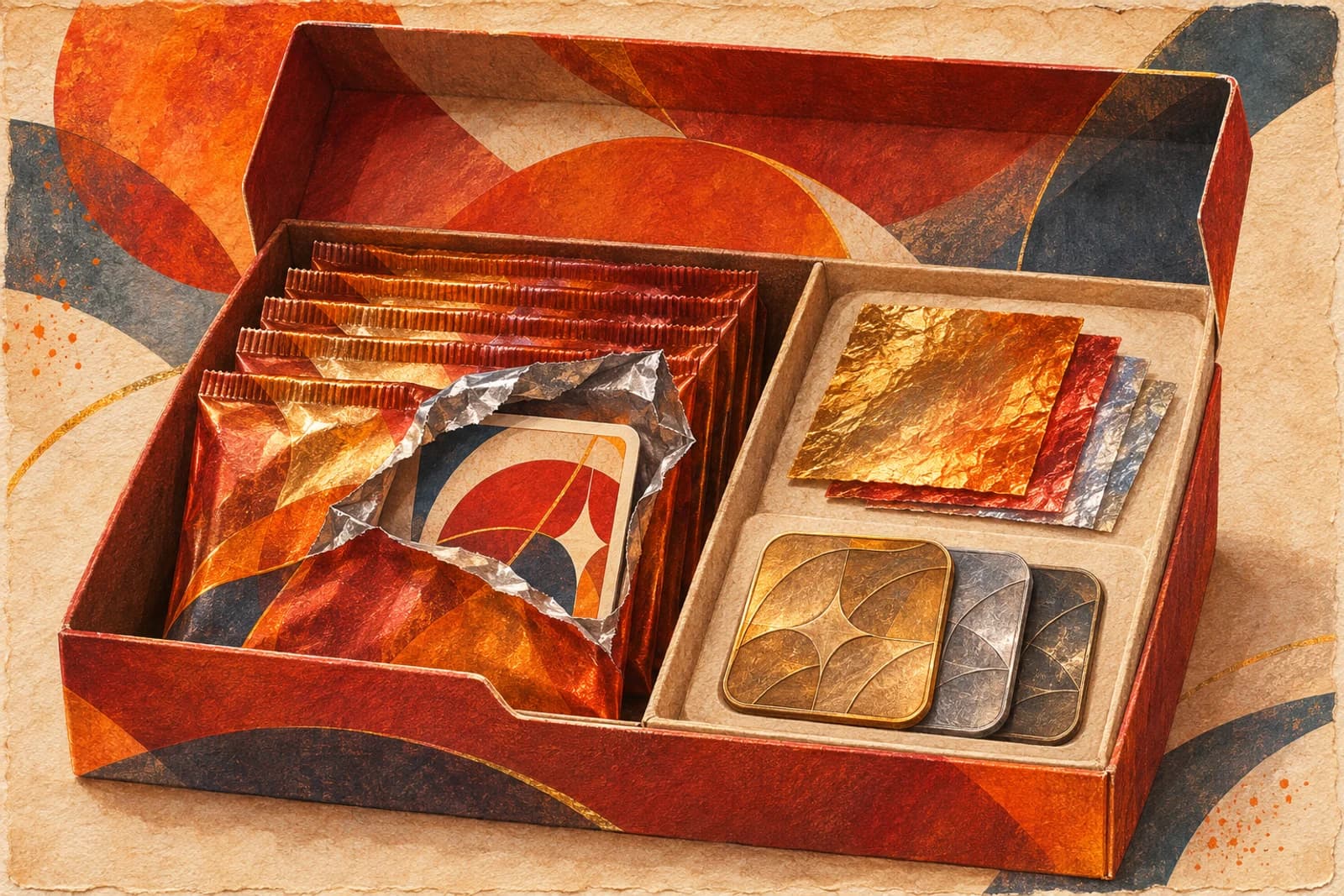
The card-evidence column is a way to test an identification, not a substitute for a handoff record. Wizards’ variant gallery presents multiple images of Queen Kayla bin-Kroog. The card’s name alone cannot distinguish the Bundle treatment, and matching the illustration does not necessarily establish the finish from a front-on photograph. A clear angled photograph can help settle that part of the printing description. The contents guide then establishes the role of the matching treatment in the Bundle. Neither reference identifies which Bundle held a loose copy or proves that the person in possession bought it at a particular store.
Picture a hypothetical player who attended a Prerelease, opened their Prerelease Pack at the table, received an anniversary card from the store, made a qualifying box purchase and bought a standard Bundle on the same visit. If they saved a photo sequence showing the stamped foil coming out separately, attach it to that copy’s record and leave the Draft Booster field empty. If a dated message from the organizer confirms the anniversary giveaway, it supports the store’s use of that route. Unless it also identifies the recipient or the handoff, keep the player’s memory of receiving the anniversary card separate. The two cards can share the same event record without sharing the same evidence of acquisition.
Now suppose the player still has an itemized receipt naming both purchases but no entry for Mishra’s Foundry. The receipt may support a qualifying purchase; it does not show that the shop supplied the promo or that the loose Foundry is the one supplied. For the Queen Kayla, the same receipt documents a Bundle purchase, and a printing match is consistent with the contents guide. If the player opened the Bundle at home and took no photographs, the opening can be noted as their account rather than as a documented extraction. The broad phrase “from Prerelease” can remain in a visit note. On the four card records, use the specific route and mark what links it to the copy. That lets someone reconstruct the afternoon without mistaking a shared date or store for a shared distribution rule.
Magic’s Bundle, Gift Bundle and the Pack Inside the Product
For the English release of The Brothers’ War, Wizards of the Coast lists eight Set Boosters in the standard Bundle and eight Set Boosters plus a Collector Booster in the Gift Bundle. The adjective “Gift” matters if you are tracing a Collector Booster to its outer packaging: the published Gift Bundle configuration accounts for that pack, while the standard Bundle configuration does not. But the distinction works in only one direction. If a collection note says someone opened a Collector Booster, the Gift Bundle is consistent with that note, not established by it. Conversely, even a well-documented Gift Bundle opening will not tell you which of its packs supplied a particular card unless the record follows the opening that far.
Use two fields for the packaging: “outer product” for the larger package that held the pack, if known, and “immediate pack” for the wrapper the card came out of. Record what you actually acquired in the acquisition field. Keep the exact publisher names in both packaging fields. “The Brothers’ War Gift Bundle” describes the outer package; “The Brothers’ War Collector Booster” describes a component. If someone broke down the Gift Bundle and passed along an unopened booster, the next owner could record acquiring the loose booster and document the immediate pack from its intact wrapper and their own opening. Without evidence linking that wrapper to the earlier box, the outer product remains unknown.
A Commander deck adds a third name that is easy to shorten into the wrong thing. Wizards lists a two-card Collector Booster Sample Pack alongside the Commander deck, separate from the deck list. “Sample Pack” is part of the product name, not a description of a Collector Booster that someone only partly opened. In a deck inventory, the two sample cards should not be logged as part of the published deck list just because they came in the same retail package. In an opening log, record the full Sample Pack name rather than grouping that opening under Collector Boosters. The contents guide distinguishes the two packages; the shared words in their names do not establish that their possible contents or insertion rates are interchangeable.
The eBay listing titled “MTG | BRO | Magic the Gathering The Brothers’ War Gift Bundle | NEW Sealed” is useful here for one narrow comparison. The seller identifies the English Gift Bundle, rather than the standard Bundle, so the title illustrates the distinction to look for in an outer-product description. Preserve “Gift Bundle” when transcribing it; a note that says only “Bundle” loses the feature that matters to the pack question. Treat “NEW Sealed” as the seller’s description, not an inspected condition. The listing cannot confirm a seal, an intact configuration or an opening, and nothing in that title connects an unrelated loose card to the box being advertised.
Consider a hypothetical recording that begins with the Gift Bundle label, shows the Collector Booster being taken out of that box and follows the same wrapper through the removal of a card. Its catalog entry could read: “Outer product: The Brothers’ War Gift Bundle, English. Immediate pack: The Brothers’ War Collector Booster. Evidence: opening footage links the labeled box, the wrapper and this card.” Save the point in the recording where the card is legible. If the clip instead begins with the Collector Booster already on the table, record what the clip shows and put the Gift Bundle attribution under the opener’s account. It may be accurate, but the footage no longer documents that link.
For a fixed insert, use the same fields without inventing a wrapper attribution. In a second hypothetical opening, a traditional foil alternate-art Queen Kayla bin-Kroog is shown being removed separately from the eight Set Boosters in a standard Bundle. Record “Outer product: The Brothers’ War Bundle, standard” and “Immediate pack: not applicable; fixed inclusion outside the boosters.” Wizards’ contents guide supports that classification, and the opening record connects this specimen to the product. “Not applicable” is different from “unknown”: the former says the card bypassed the boosters, while the latter would leave open whether an immediate pack existed. If the copy later changes hands, its trade record can be added without altering those packaging fields.
The level of proof worth saving depends on the collection. For a display comparing the standard and Gift Bundles, the publisher’s contents guide can establish which configuration to illustrate, and a correctly identified but unlinked Collector Booster can serve as an example if the label says so. For a collection that reconstructs the contents of one particular Gift Bundle, a pile of compatible loose cards is not enough. Even a receipt naming the Gift Bundle documents the purchase, not the path from the box to the individual card. In that collection, leave a copy’s outer product unresolved when the evidence begins at the wrapper. You can still file the card by printing without counting it as a documented pull from that box.
Three Numbers You Can’t Substitute for One Another
Wizards of the Coast used two different units to describe serialized retro schematics in The Brothers’ War. Its release announcement said there would be 500 copies of each serialized retro schematic for Collector Boosters. Its booster contents guide said serialized retro schematics appeared in less than 1% of Collector Boosters. The first number is a publisher production claim about an individual design in its serialized treatment. The second is a publisher insertion claim about packs containing a card from that category. Neither is an independent count. In a catalog, “500 per serialized design” and “less than 1% of Collector Boosters for the category” belong in different fields, with their units intact.
The wording “less than” matters. It supplies a threshold, not an exact rate, and it is not a promise of one hit in every hundred packs. The guide also names Collector Boosters, not all Brothers’ War boosters, not all sealed products and not the two-card Collector Booster Sample Packs. Substituting “boxes” for “packs” changes the question. A Gift Bundle may be configured to contain a Collector Booster, but the publisher’s threshold does not document the contents of an individual Gift Bundle. A photographed sealed product that could contain an eligible pack is not evidence that its pack contains a serialized card.
To estimate the chance of opening a named schematic, you would need more information than the overall threshold. How much of the category’s insertion rate belongs to that design? Were pack allocations uniform across the pool you are considering? The supplied figures do not establish the exact rate or that allocation. An announced equal production quantity for each serialized design is not a documented model for how those cards were sorted into packs. A particular serial number narrows the claim further. Dividing the category threshold by 500 would treat the whole category as though it were one design, then turn a bound into an estimate without evidence about the relevant packs. The guide provides no odds for an individual serial number.
PSA’s Population Report uses a third unit: the grading records in the category you looked up. Suppose, for illustration only, that a search for a hypothetical serialized treatment shows 14 under an exact variety label across grades, with six in one grade. Record those as a hypothetical category total and a hypothetical grade-level count, not as two estimates of the number produced. Save the grader’s name, the label as displayed, the grade if one was selected and the lookup date. PSA also notes that it sometimes starts labeling a variety after it has already graded examples of the issue. Older entries may not reflect the later distinction, so even a correctly transcribed result describes what that search returned, not necessarily every example PSA has handled.
None of these sources supplies a survival count. The production statement does not track what happened to the announced copies after manufacture. The insertion statement describes a distribution mechanism, not how many packs were opened or what became of the cards. And the population report does not observe copies that never entered PSA’s records. In the hypothetical search, subtracting the category total of 14 from the announced 500 would not show how many copies remain ungraded, how many are still sealed in packs or how many can be located today. It would subtract a count of grading records under one label from a publisher’s claim about production, then assign the remainder a meaning neither source gives it.
That distinction is useful when reviewing a seller’s description. Suppose a seller shows a legible serial mark and describes the card as “one of only six left,” pointing to a grading result for one grade. The image may support a transcription of the mark, and the grading result may support a dated observation about the grade category. Neither supports “left.” Likewise, “number 127” is a specimen identifier in the example, not a measurement of how early the card reached stores. Keep the seller’s interpretation out of the active description. If the digits are obscured, request a clear image of the mark rather than filling them in from a listing title or from the expected denominator.
A hypothetical catalog note might read: “Visible serial mark transcribed as ‘127/500.’ Wizards announced 500 copies of each serialized retro schematic and described the category as appearing in less than 1% of The Brothers’ War Collector Boosters. The denominator on the card is consistent with the publisher’s stated per-design quantity. The pack figure applies to the category, not this design or serial number. No copy-specific opening record supplied. Production and pack collation not independently audited for this catalog.” If a grading observation belongs with that record, add it as a separate dated entry. That preserves what can be read on the specimen without turning the printed denominator, an announced pack rate and a grading search into competing answers to the same question.
One Piece: When the Card List Names an Event but Not the Award
Bandai’s official English ONE PIECE CARD GAME promotion card list gives collectors two things to read together: the card image and a field labeled “Information Obtained.” The list shows more than one P-001 Monkey.D.Luffy image associated with Super Pre-Release. If a loose card’s printed identifier is legible, P-001 gets you to the relevant entries without necessarily selecting one. And if a seller’s description says “Super Pre-Release,” that does not break the tie when the same broad association appears with more than one image. Start by comparing the visible design to the individual images, then transcribe the distribution wording from the entry that actually matches.
Bandai’s historical roadmap makes the limits of that wording easier to see. It distinguishes the Super Pre-release starter decks from the full-release starter decks and the full-release booster pack. It also lists a store Super Pre-release tournament separately from the product milestones. Those separate lines are useful when reconstructing the publisher’s rollout: a starter deck milestone and a tournament milestone are not the same kind of event. But the roadmap is a planning document. Its separation of the tournament and the products does not tell you which image in the card list belonged to a particular award tier, whether a named store held its event as planned, or when someone received the copy you are handling.
Make the catalog reference precise enough for someone else to repeat the comparison. For a matched entry, save the English promotion list’s title, the printed identifier, the exact “Information Obtained” wording and the date you consulted it. Keep a reference to the individual image if available. If the site provides no stable reference for that entry, keep a dated capture that shows the image together with its corresponding text, and note the visible design detail that settled the comparison. A clipped image alone may establish what you were comparing, but not which distribution wording accompanied it. A search result that shows the card name and the event label may omit the adjacent image altogether. Avoid making either fragment the sole record of the match.
Suppose a hypothetical intake photo shows P-001 and enough of the name to identify Monkey.D.Luffy, but another card overlaps the part of the front needed to compare the listed images. The seller calls it a winner’s award and points to Bandai’s Super Pre-Release wording. A working entry could read: “Printed identifier: P-001. Image match unresolved: relevant part of front obscured. Publisher candidates: multiple English promotion entries associated with Super Pre-Release. Seller reports winner award; no award terms or handoff record supplied.” Keep both candidate references in the file instead of attaching one as though it were confirmed. The seller’s statement is a lead about what to look for, not a way to choose between images.
For the design question, request a straight-on photograph of the complete, unobstructed front at a resolution that makes the printed markings legible. Compare it against each candidate, not just the first image returned for P-001. Both promotion entries say “Super Pre-Release,” but one image shows a prominent WINNER marking. Bandai’s event notice identifies the silver-foil P-001 as the champion prize and lists a separate P-001 participation card. If the new photo supports a match to the Winner version, record that identification and its announced award tier. The photograph still does not show who received the copy or where it was awarded.
For the award question, look for contemporaneous material from the relevant venue or organizer that names the particular distribution and connects it to the specific version, such as a prize sheet that pairs an image with the award tier. A notice advertising a prize would establish the intended terms. A dated report from the organizer documenting the completed event or its results would address whether the tournament took place and who placed where. Neither necessarily links this loose card to a recipient. A handoff photograph that shows both the recipient and an identifiable card, or a dated award record that identifies the version and can be tied to the copy through later records, would speak more directly to that last claim.
Keep the dates as separate entries even if they eventually agree. Enter any date taken from the roadmap as a planned milestone, with the product or tournament line it describes. Enter a date from a completed-event report as evidence for that specific event. Use a handoff date only when a record actually supports receipt, and give your own intake date its own field. In the hypothetical case, if the unobstructed photograph confirms the winner design, the sleeve can read “Monkey.D.Luffy P-001 | Super Pre-Release Winner version” even if no local records surface. If the version remains unresolved, leave the award tier off the label. A binder arranged around the official promotion images can accept a supported version match; a display about a named tournament’s awards still needs evidence connecting the copy to that tournament.
One Piece: Participation Pack, Winner Pack, Winning Player
Jinbe EB02-055 has separate entries in Bandai’s English promotion card list for Tournament Pack 2025 Vol. 3 and Winner Pack 2025 Vol. 3. The shared identifier gets you to both entries, not to a choice between them. If a seller describes a loose copy as a winner’s card, ask which claim is being made. “This matches Bandai’s Winner Pack entry” is a claim about the version. “The person who sold it to me won a tournament with this as the prize” is a claim about a result and a handoff. The first can be supported without establishing the second.
Bandai Namco Amusement America’s official-shop tournament notice shows how that shop assigned the packs for a different volume. It names Tournament Pack 2025 Vol. 1 as the participation prize and Winner Pack 2025 Vol. 1 as the winner prize. That is evidence of the shop’s advertised terms for Vol. 1. Bandai’s card list does a different job for Vol. 3: it pairs versions of Jinbe with their respective pack names. Neither document supplies the terms of a particular Vol. 3 tournament. To establish what a named venue offered at that event, look for a notice covering that venue, event and volume rather than importing the Vol. 1 terms.
For a hypothetical intake, suppose the front of a loose Jinbe is clear enough to match the image associated with Winner Pack 2025 Vol. 3. The collector can record that match without accepting the seller’s account that the card was awarded for first place at a local tournament. Write “Winner Pack 2025 Vol. 3 version, matched to Bandai’s English card list” in the version field. Put the named tournament and the account of the award in a separate note attributed to the seller. If the available photo shows the code but does not settle the comparison with the two listed images, keep both pack entries open as identification candidates.
Now suppose the seller supplies an empty original wrapper with the full Winner Pack 2025 Vol. 3 name legible. The wrapper establishes which pack the packaging represents and makes the claimed opening more specific. It does not identify its contents after the fact. The fact that the wrapper and the card arrived in the same envelope shows that the seller sent them together, not that the card came out of that wrapper. A dated opening sequence that shows the printed pack name and follows the card as it comes out would support a stronger claim. Even that sequence might not show how the opener obtained the pack.
A tournament result supplies a different piece of evidence. Imagine that the organizer’s dated standings identify the seller as the winner of the event named in the listing. Those standings support the claim about the seller’s finish. If they do not name the prize, they do not establish that a Vol. 3 Winner Pack was awarded. A contemporaneous prize notice naming the pack would establish what the organizer offered, but even the two records together would not show that the loose Jinbe came from the awarded pack. An award record naming the recipient and pack could support the handoff while still leaving the opening unrecorded.
The strongest lead depends on where the account breaks. If the seller can show the opening but not the award, ask for something that connects the pack shown in the opening to the named tournament. If the seller has an award record but no opening evidence, ask whether there are dated images or notes linking this copy to the pack before it became mixed with other cards. An event result and a correct wrapper are both worth preserving even when that last link is missing. File the former as evidence of placement and the latter as associated packaging, rather than using either to fill a gap in the copy’s history.
The Smithsonian’s registration policy offers a useful distinction here: description, acquisition source and provenance need not share a single entry. In the hypothetical Jinbe record, the description can name the version, the acquisition field can identify the recent seller, and the provenance note can say which parts of the tournament story are supported. Give the card and wrapper separate entries if you keep both. Link them with a note such as “received together from seller; original association not established.” Keep the standings with the event record. That arrangement preserves the evidence without making a future reader infer that everything in the file belonged together before the sale.
For a binder organized by Bandai’s promotion entries, a supported Winner Pack image match can be enough to fill a slot. For a display documenting the prizes received by a named player, the same card can illustrate the version but should not stand in as that player’s documented award. The short label in the first binder can name Jinbe, EB02-055 and Winner Pack 2025 Vol. 3. A display label for the second purpose needs the qualification “example of the version; link to the award unconfirmed.” The missing evidence is not a better account of who won. It is a record connecting that result and prize to this physical card.
Yu-Gi-Oh!: One Store Counter, Two Distribution Rules
Konami’s North American Lost Art promotion page and its OTS Tournament Pack 26 product page both point collectors to Official Tournament Stores. That common setting does not make the offers interchangeable. Under the posted Lost Art terms, a qualifying purchase of sealed Yu-Gi-Oh! products at a participating store can make a customer eligible for the offer. Konami describes OTS Tournament Packs as not-for-sale items supplied to Official Tournament Stores to reward tournament play. A store name may help locate the records you need, but the rule that connects the store to the card depends on which program you are tracing.
In a Lost Art record, distinguish eligibility from fulfillment. Konami makes the posted offer conditional on supply and says the schedule can change. Evidence that a purchase met the applicable terms does not establish that the store had the promo in stock or gave it to that buyer. The page is also a live campaign reference, not a fixed record of the terms for every past Lost Art card. If the claim concerns a historical purchase, look for terms that cover the relevant card, date and market. A saved copy of the applicable announcement can show what customers were told at the time without proving what happened at the counter.
For OTS Tournament Pack 26, the publisher’s page documents the intended channel, but it does not tell you whether a particular player received a pack, at which event, or for which result. Do not translate “reward for tournament play” into “first-place prize.” If the collector’s question is how a specific store assigned packs, a contemporaneous notice for that tournament is more relevant than a general product description. If the question is whether a named player received one, seek a record that actually addresses the award. A result may establish how the player finished without saying anything about the pack they took home.
Consider a hypothetical collector who buys a loose Lost Art card online. The seller gives them a dated receipt from a participating Official Tournament Store, with a line for sealed Yu-Gi-Oh! products but no line for a promo. If the purchase can be checked against the offer in effect at the time, the receipt may document a qualifying transaction. If the description is too broad to check the purchase against those terms, say only that it supports a sealed-product purchase. Neither reading proves that the store fulfilled the offer. The online purchase is a separate transaction, and the collector can document it even while the claimed store handoff remains unresolved.
For the receipt example, a useful next record would be a contemporaneous transaction document naming the promo, or a dated store message confirming that it was supplied with the purchase. That would strengthen the evidence for fulfillment. It still matters whether the seller can connect the loose copy now offered to the one described in the record, particularly if the seller owned several copies. A local notice announcing the offer is helpful for checking the store’s participation and the applicable dates, but it cannot supply that link. Ask for a record of the transaction or handoff when that is what the catalog entry is meant to establish.
Finish belongs in a separate field. On its OTS Tournament Pack 26 page, Konami distinguishes the OTS Ultimate Rare treatment from the Prismatic-style Ultimate Rare treatment used in Rarity Collection sets. If a seller calls a card “Ultimate Rare,” retain that wording as the seller’s description until you can compare the specimen with the relevant publisher reference. Record the printed identifier as well as the finish, and ask for an angled photo if the existing image does not show the surface clearly. Even a supported finish match helps identify the version rather than documenting a recipient, a tournament result or a purchase at a particular store.
The marketplace example also works in the other direction. Suppose a loose card matches an OTS Tournament Pack 26 printing and the current owner has an invoice for buying it from another collector. The invoice supports a later purchase. It does not turn the original pack into a retail product or contradict Konami’s account of how OTS packs were supplied. Conversely, “not for sale” in the product description does not establish that every loose copy with a matching design was personally won by the seller now offering it. The intended route and the observed resale can coexist in the catalog without requiring a reconstruction of every transfer between them.
If you are sorting cards for a display about Official Tournament Stores, give purchase-triggered promotions and tournament-pack issues separate headings even when the same shop appears in both histories. For the hypothetical Lost Art card, write “Recent marketplace purchase documented; earlier store receipt does not name promo.” For the hypothetical OTS card, write “OTS Tournament Pack 26 printing match; later private purchase documented; original recipient unknown.” Keep the publisher’s finish term with the printing description where it can be supported. This lets the store serve as a useful search field without letting its name stand in for a distribution rule or turning a later sale into evidence of an original handoff.
Dark Magician and the Two-Wave Problem
Konami’s English database gives DTP1-EN002 two dated entries for Dark Magician. It lists Duel Terminal Preview Wave 1 on August 4, 2008, and Duel Terminal Preview Wave 2 on June 20, 2009. Both rows are relevant to a search for the printed identifier. A loose copy with that code and a matching rarity has not, on that evidence alone, been assigned to either wave. The two dates describe the database entries, not observations about the card in hand. Entering the earlier date in the card’s record would make a choice the identifier and rarity have not justified.
Keep the date attached to the entry it describes. In a spreadsheet, the same physical card can point to two candidate release rows, each with its own publisher wording and date. If you use a single-sheet catalog, put both candidates in a note and leave the copy’s wave field marked “unresolved.” Do not enter August 4, 2008, as a default and rely on the note to undo it. A filter or a printed binder index may show the date without the note. An unresolved field preserves the uncertainty when the record is sorted, exported or read by someone who never saw the intake photographs.
RA04-EN106 shows why the next step depends on what the database actually records for the identifier. Konami lists that Dark Magician code for Quarter Century Stampede across illustrations and two rarity designations. A collector can compare the artwork on a loose copy with the listed images, then use the rarity designation, if supported by the specimen, to narrow the match. If the art is clear but the finish is not, record which candidates the art rules out and leave the rarity decision open. A second photograph that shows the surface can help with that comparison. The code alone does not make those additional observations redundant.
Do not assume the RA04-EN106 approach will also resolve the DTP1-EN002 wave. The consulted database rows do not establish a physical feature that distinguishes the two Preview waves. That is a limit on the evidence, not a finding that the cards are physically indistinguishable. A full front and back photograph is useful for documenting the specimen and checking what was transcribed. A sharper photograph cannot, by itself, supply a reliable wave criterion. To classify by a visible feature, you would first need a reliable reference that establishes that feature’s connection to a specific wave, and then a view of the specimen that lets you check it.
A reminder from a previous owner might suggest a different line of inquiry. Suppose a seller attributes a hypothetical DTP1-EN002 copy to Wave 1 and supplies a dated photograph from before Konami’s listed Wave 2 date. First ask what is visible. If the image shows only a Dark Magician illustration with no legible code, it may not establish that the card is DTP1-EN002. If the code is legible, the photograph may support possession of a copy of that issue by the time it was taken. To apply it to the card now being sold, you still need a defensible connection between the photographed object and the current specimen.
A separate contemporaneous record that names the wave and links the card to its original acquisition would answer the question more directly. A later sale receipt that simply repeats “Wave 1” can show how the item was described when it changed hands, but it is not independent evidence of that earlier acquisition. Likewise, a record showing the card was first photographed after June 20, 2009, does not select Wave 2: a copy from the earlier wave could still have been in circulation. Preserve the date and the observation it supports rather than treating the timing of any available document as a substitute for a wave attribution.
A hypothetical entry could read: “C-027. Dark Magician. Printed identifier: DTP1-EN002. Identifier and observed rarity checked against Konami’s English database. Candidate entries: Duel Terminal Preview Wave 1, August 4, 2008; Duel Terminal Preview Wave 2, June 20, 2009. Wave unresolved. Seller reports Wave 1; no copy-specific wave evidence supplied. To resolve: seek a contemporaneous acquisition record identifying the wave and tied to this specimen, or a reliable wave-specific reference that can be checked against it.” Following the Smithsonian’s separation of object description and provenance, keep the seller’s account and any supporting material in the record without making either part of the verified printing description.
If the binder is arranged by printed identifier, C-027 can occupy the DTP1-EN002 slot without a wave assignment. If the binder is meant to document both Preview waves, it can sit in a provisional slot rather than being counted as either one. Buying a second copy advertised as the other wave would give the collector two specimens and two seller descriptions, not necessarily a documented pair. This is where the contrast with RA04-EN106 matters in practice: a binder organized by its listed illustrations and rarities can use observed details to allocate slots, while a wave-based binder should keep those slots open until it has evidence that actually separates the candidates.
A Release Timeline Needs More Than One Date
A search for a card’s release date can turn up the day its artwork was announced, the day a retailer was supposed to start handing it out, or the date a rules document uses to describe format eligibility. Each can be correct without answering when anyone first received a copy. Before entering a date, write the sentence it completes: “The winners were announced on,” “The retailer offer was scheduled to begin on,” or “This copy was in the collection by.” The verb is part of the evidence. Without it, a catalog sorted by date can quietly turn a publisher’s plan into a history of things that happened.
A spreadsheet template can start with four fields: announcement; announced distribution start; format eligibility; observed acquisition. For each entry, keep the date or period as stated, the source, and a note on what the date applies to. In the distribution field, include the route and market. In the eligibility field, name the format and the period covered by the rules. In the acquisition field, distinguish an observed handoff from evidence of possession by a certain date. If a card has several announcements or distribution routes, give each one a dated entry rather than forcing them to share a cell. Mark a missing date “not established” instead of borrowing one from a neighboring field.
The Pokémon illustration-contest promos show how the template works. In the announcement field, enter “September 23, 2024: contest winners announced; selected artwork intended for promo cards.” Add the later North American Pokémon Day campaign as a separate announcement entry. In the distribution field, record “February 21, 2025: announced start of participating retailer gift-with-purchase offer, while supplies lasted.” Record the giveaway at participating Pokémon League celebrations on its own line, with the date of any particular celebration still to be established. The February 21 date belongs to the retailer route. Neither announcement fills the observed-acquisition field for a family’s loose promo, and neither cited announcement establishes its eligibility in a named format.
Bandai’s historical ONE PIECE CARD GAME roadmap belongs in a planning timeline. Its sequence distinguishes the Super Pre-release starter decks from the starter decks and booster pack planned for full release. The store Super Pre-release tournament is listed separately from those product milestones. Transcribe each relevant milestone with its own label, and treat its position or date on the roadmap as part of the published plan. If a collector later finds a store’s dated report of a completed tournament, that report can support an actual event date. It should sit beside the planning entry, not overwrite it. If the report says nothing about when a particular player received a card, the acquisition field remains open.
Wizards of the Coast’s release notes for The Brothers’ War illustrate why format eligibility needs a time frame of its own. The notes distinguish cards with the BRO set code from the BRR Retro Frame Artifact reprints when discussing legality. A BRR reprint’s appearance alongside the release does not, by itself, make the card legal in Standard. And the Standard set list in the notes describes the format around the release, not the format today. A historical entry can read “Standard, at The Brothers’ War release: consult the release notes’ separate treatment of BRO and BRR.” For a deck being built now, leave the current-legality field unchecked until you consult a current rules reference for that format.
Record dates only as precisely as the evidence allows. Suppose a hypothetical collector’s contemporaneous notebook says “February 2025” next to an entry for a promo received at League. Enter “2025-02, day not recorded,” and identify the notebook as the source. Do not enter February 1 to make the date sortable or February 21 to make it fit the retailer campaign. If a relative says “around February 2025,” preserve “around” and identify the information as recollection. For software that insists on a full date, keep the incomplete date in a text field and use a separate year-and-month sort field. A software requirement is not evidence for a day.
Now suppose the earliest dated photo in that hypothetical collection shows the promo clearly in a binder on March 8, 2025. If there is a sound basis for linking the photographed card to the copy being cataloged, write “In collection by March 8, 2025; dated binder photo.” Do not enter March 8 as the acquisition date. If the family owns several matching copies and cannot distinguish them in the image, the photo establishes that the collection held an example by then, not necessarily this specimen. It does not identify the League or retailer route, prove fulfillment on a particular date, or establish current legality. If the collection is arranged by artwork, the dated photo can be useful even with those questions open. If the display is about what a specific store handed out on launch day, the same photo does not meet that narrower requirement.
What a Slab Certifies and What the Lookup Does Not
An online listing for a graded card puts two different things in the same photograph: a card and a label bearing a certification number. PSA’s Cert Verification service returns the company’s record for that number. It can tell you whether PSA holds a record consistent with the details a seller presents. It does not inspect the holder or card in the photograph. PSA warns that a genuine number can be copied onto a counterfeit insert. A successful lookup therefore answers a narrower question than “Is this the item PSA examined?” Keep the listing image, the returned record and the publisher’s printing reference side by side so that each can be compared without substituting for another.
Consider a hypothetical listing for a graded Queen Kayla bin-Kroog that the seller describes as a Bundle card from a particular release event. The listing has a readable label and a clear front image, but its lighting is poor for judging the foil. Transcribe the cert number as shown, then enter it in PSA’s official lookup rather than treating a seller’s screenshot as the lookup result. Compare the number on the photographed label with the returned record, then compare the recorded card name, grade and label description with what the photograph shows. Check the card code or collector number wherever it is shown, and note whether it came from the label, the record or the card itself. A detail missing from one of those places is not a disagreement.
Record the grading label verbatim, including abbreviations, punctuation and any printed variant wording. Then put the publisher’s terminology in a separate field. In the hypothetical example, suppose the label shortens the treatment to “ALT ART,” while the publisher describes a traditional foil alternate-art Bundle inclusion. Keep the shorthand as hypothetical label text, not as a statement that PSA uses that wording for every copy. Do not expand it inside the transcription or quietly import the publisher’s finish term into it. If someone reviews the record later, they should be able to tell what the holder actually said and which parts of the identification came from other evidence.
Use Wizards of the Coast’s variant gallery to compare the visible card with the stated printing. The gallery shows more than one Queen Kayla bin-Kroog image, so recognizing the name is not enough. Look at the illustration and the treatment shown in the relevant entry, and compare card numbers where legible. If the visible art matches but glare prevents a reliable finish comparison, record those as two separate findings. The gallery illustrates the intended design; it does not tell you how the photographed surface looks from another angle. The same principle applies in Konami’s English database: a Dark Magician code such as RA04-EN106 can lead to multiple illustration and rarity entries, so a matching code alone need not settle the variant.
If PSA provides reference images for the certification record, compare them with the listing image as well. Look for agreement in the visible artwork, card code and label details, and note whether the views are clear enough to compare the holder and card at all. Do not treat the lack of a useful image as a mismatch. A discrepancy that can be explained by glare or an unreadable number calls for a better photograph. A clearly different illustration or a grade that does not match the returned record calls for an explanation before you rely on the listing’s identification. Conversely, agreement across the images is evidence of consistency, not proof that the seller controls the pictured item or will send that item.
A practical note for the hypothetical Queen Kayla might read: “PSA lookup returned a record consistent with the photographed label for the displayed certification number. Card name and readable number agree where shown. Visible artwork matches the publisher’s alternate-art image; surface treatment not independently resolved in listing photos. Photographed item not physically examined.” Add the lookup date and preserve the verbatim label in its own field. If no PSA reference image was available, say so. If a clearer photograph later shows the foil, update the surface observation rather than upgrading the whole entry to “verified” on the strength of a single new view.
The seller’s event claim should remain outside that note. Even a plausible match among the cert record, slab label and publisher image does not name the event, identify the original recipient or establish prior ownership. A seller asserting that the card was opened at a particular release gathering would need evidence connecting this copy to that opening, not a second confirmation of the same cert number. A collector choosing an example of the artwork may be able to assess the printing from the available images while still reserving judgment about the offered slab. A collector documenting a particular player’s cards has a different decision: without a link to that player, the certification record does not fill the slot, however closely the visible details agree.
Assign the Card an ID That Can Outlive a Correction
Give each physical card a local number when it enters the collection, even if you cannot identify its printing yet. A number such as C-1042 works because it says nothing about the set, product, wave or grade. You can move the card to another binder or revise the identification without renaming the photos, receipts or notes filed under that number. The National Museum of American History’s registration policy supplies the underlying distinction: an object number is separate from physical description, acquisition method, source and provenance, and supporting documentation has its own place in the registration file. A collector can borrow that structure without treating it as a museum standard for identifying or authenticating cards.
For a small collection, one spreadsheet can do the job. Use one row per physical copy and start with these columns: local ID; card name and printed code as seen; language, illustration and finish; active printing identification; documented distribution reference; copy-specific origin and status; intake date and method; source reference; current location; evidence folder. The source reference can be a private seller or trade record number rather than a name. Put the publisher’s product or release entry in the distribution column, not an unsupported claim about this copy. If you received the card loose, record the means of intake, such as a trade, even when the earlier distribution history remains unknown.
Decide what each status means before using it to filter the sheet. “Not assessed” means the feature has not been checked, perhaps because a photo does not show the finish. “Unresolved” means you have checked the available evidence and cannot yet choose among candidates. “Reported by seller” identifies who made a claim without endorsing it. “Not applicable” is useful when no corresponding field exists, as with an immediate booster field for a documented fixed insert. Keep what you can see separate from what you infer: transcribe the collector code literally, then identify the matching publisher entry in another cell. That way a corrected interpretation need not alter the original observation.
Consider a hypothetical Dark Magician entered as C-1042 on April 11, 2025. A seller attributes the card to Duel Terminal Preview Wave 1, but the intake image cuts off the printed code. The collector records that attribution as provisional. On April 12, a clearer photograph of the same specimen shows RA04-EN106. Konami’s English database associates that code with Quarter Century Stampede, while its two dated Duel Terminal Preview entries carry DTP1-EN002. The clearer image rules out the seller’s Wave 1 attribution for this card. It does not settle every detail of the replacement identification: the database lists RA04-EN106 across illustrations and two rarity designations, so a code match alone does not resolve the exact treatment.
Change the active record to “Dark Magician, RA04-EN106, Quarter Century Stampede; exact treatment pending.” Remove the Wave 1 association from the active distribution field. In a dated revision note, preserve the earlier wording, its source and the reason it was superseded: “April 12, 2025: seller’s Wave 1 attribution ruled out by legible printed code in new specimen photo; compared against Konami’s English database.” Keep the original intake image and the clearer replacement view. The seller’s statement can remain in the history without appearing in a current binder export. The local ID, acquisition method and intake date stay as they were; the new photograph did not change who supplied the object or when.
For a larger collection, split the spreadsheet into linked sheets. A Copies sheet holds the local ID, acquisition record and current location. A Printings sheet holds the code, language, illustration, finish and identification references. A Distribution sheet describes products, events or campaigns, with the publisher’s wording and the market or date where supported. A link sheet can associate one printing with multiple distribution entries and mark which are candidates rather than confirmed matches. Use an Evidence sheet to show which item supports which claim and a Revision sheet for dated changes. That setup takes more work than one row per card, but correcting a shared printing description no longer means hunting through every duplicate row.
Duplicates are the test of whether the system is working. In a hypothetical pair, C-1042 and C-1097 eventually match the same illustration and rarity and point to the same printing record. One came in a trade and sits in Binder A; the other was purchased in a holder and sits in Box 3. Only the latter has a photographed grading label. Preserve that label verbatim and record the certification number and lookup date with C-1097, not with the shared printing. PSA’s lookup reports the company’s record for the number, and PSA warns that genuine numbers can be copied onto counterfeit inserts. A consistent lookup does not authenticate an offered item or say anything about the other copy.
Generate sleeve labels or a public index from the active fields, not from a catchall notes column. The label for C-1042 can change from a provisional identification to RA04-EN106 while old images and the correction remain findable under the same number. If you later confirm the exact rarity, update the printing link and record how you did it. If the card changes storage locations, update the location without editing its acquisition history. Someone checking the binder should be able to find the card quickly; someone checking the disputed attribution should be able to reconstruct the decision without mistaking the first entry for the current one.
Save the Paper Trail, Not Just the Card Photo
The Strong’s guide to its archives catalog distinguishes a collection’s scope and arrangement from the inventory used to locate material within it. A home collection benefits from the same division. Write a short description of what the archive covers and how it is arranged: for example, English One Piece promotion cards, associated wrappers and store materials, with records organized by physical copy or event. Then keep an inventory that points to individual files. The description tells a future reader why they might look there; the inventory tells them where to look. Neither should imply that a receipt or wrapper survives merely because the collection description mentions those kinds of material.
Start an inventory entry when you take the card photographs. Give the front and back separate file names that share the local ID, and identify any additional view by what it shows, such as the foil surface or a legible printed code. For a wrapper, photograph the side that names the product or pack, not just the illustrated face. If the wrapper arrived with a loose card, record that association as observed at intake. Do not file it as the card’s original wrapper unless there is evidence of the opening. For a receipt, identify which line bears on the claim and whether it names the card, a qualifying product or only a general merchandise category.
For each saved page, record its title, original address, capture date and a sentence explaining why it matters. Keep the date printed on the page, if any, separate from the date you saved it. A note like “organizer advertised this pack for this event” will be more useful later than “proof of promo.” Save enough context to show the issuing organization, date and exact product or event wording where the page includes them. A cropped capture can make a card image easier to compare, but keep the fuller view too if the relevant text sits beside it. If a reference changes, retain the dated captures separately rather than overwriting the version that supported your original entry.
A shared binder index needs less information than the archive behind it. It can show the card’s local ID, description and an entry such as “private acquisition record on file.” Keep names, addresses, payment details, order numbers and private correspondence out of that shared view. Make a separate redacted copy if someone needs to inspect the relevant part of a receipt; retain the original in the restricted file rather than replacing it. This adapts the Smithsonian registration policy’s practice of retaining supporting documentation with the object record. The receipt remains available to a person who needs to check the acquisition, but its personal details do not travel every time the binder index is exported.
The Strong’s account of collectible card game research shows why it is worth preserving material that does not picture the card at all. A museum fellow reports using collectible card periodicals and finding publisher catalogs, trade flyers and player publications. Records in the Mayfair Games archive also shed light on design, printing and retail problems. Those examples suggest where to look when an online product or event page is gone. They do not establish that a particular flyer or store record survives. Use a finding aid to identify a collection or inventory entry worth investigating, then examine the actual document before crediting it with a claim.
Imagine a hypothetical seller attributes a card to a tournament at a named store, but the store’s event page no longer loads. The question is not simply whether another copy of the page can be found. First work out what is missing. If you need to know what the shop advertised, a dated store-calendar capture, a printed flyer or an organizer’s event email might name the pack and who qualified for it. A publisher catalog could help identify the pack without supplying the store’s terms. A later player publication might point to a report or reproduce an announcement. Check which it does: a reprinted flyer is still an announcement, not a report that the tournament happened.
If the missing fact is whether the store held the event, look for completed standings, a dated organizer recap or photographs that identify the venue and occasion. Even a completed result need not say which prize was handed out. For that, a dated award record naming the recipient and pack would be more informative. To connect the loose card to the award, look for evidence spanning the next step, such as an opening record that shows the identifiable pack and card and can be tied to the recipient’s records. If only a flyer and a standings sheet turn up, preserve both and describe their separate contributions. The archive now documents more than the missing webpage alone, but it may still leave the copy’s origin open.
Index an event file once and link it to each relevant card rather than scattering copies of the same flyer among specimen folders. Give each link a note about its role: one card might match a pack listed in the notice, while another has a separate record placing it with a recipient. If you find an opening photo later, add it to the specimen’s evidence and leave the event notice where it is. A reader following the binder ID should be able to retrieve the front and back, find the exact notice you relied on and tell which document, if any, moves the account from an advertised offer to a documented handoff.
Four Binder Labels That Say Exactly Enough
Try writing the sleeve label before reading the seller’s description. For each of the four hypothetical intake packets below, use the shortest wording that would let another collector file the specimen correctly. Then open a separate catalog note and ask what the same evidence would justify if someone wanted to reconstruct the card’s arrival. The short label can be decisive about a checklist slot while the longer note keeps a narrower question open. If the seller’s story supplies a worthwhile lead, preserve it as a reported claim in the private record, not as part of the label.
Packet one: a loose English Mew ex with a legible number 151 and visible details that agree with the Scarlet & Violet 151 expansion checklist. The packet contains front and back photos but no packaging or opening record. Sleeve label: “Mew ex | Scarlet & Violet 151, no. 151.” Catalog note: “English expansion checklist match at no. 151. Pokémon’s Prize Pack Series Five list also includes Mew ex as MEW 151; that entry is a distribution reference, not evidence that this specimen came from Series Five. Finish recorded separately only to the extent the images show it. Immediate container and original acquisition unknown.”
Leave “pulled from Prize Pack Series Five” off the sleeve unless the evidence supports it. Start by checking the front photo for the Play! Pokémon logo, which Pokémon says appears on Series Five cards. That helps distinguish a Prize Pack printing from the ordinary expansion printing, but it does not show a particular opening. For that claim, look for a contemporaneous sequence showing the Series Five wrapper and the card as it is removed, with a basis for linking the card shown to the specimen now in hand. If no such record turns up, the card can still fill the numbered slot in a binder that uses the expansion checklist to define its slots and does not require a specific printing.
Packet two: a Queen Kayla bin-Kroog whose illustration matches the Bundle art in Wizards of the Coast’s variant gallery. The supplied image is straight on, and the surface is not clear enough to confirm traditional foil. There is no opening record. Sleeve label: “Queen Kayla bin-Kroog | Bundle art match.” Catalog note: “Illustration matches the Bundle design in Wizards’ gallery. The contents guide lists the traditional foil alternate-art card as a fixed Bundle inclusion outside the Set Boosters. Finish not confirmed from the intake photo. No evidence links this copy to an individual Bundle or opening.” The short label identifies the artwork without claiming every element of the treatment.
Leave out “opened from a standard Bundle at Prerelease.” For this packet, request an angled photo that shows the surface clearly. That is the useful next piece if the collector wants to file the specimen as the traditional foil treatment rather than merely as an example of the art. It would not establish when or where the card was opened. A gallery-based binder that requires only an illustration match can accept it now; a binder that requires the complete fixed-insert treatment can hold the slot pending the finish check. Neither needs the seller’s event story to make that decision.
Packet three: a Jinbe with EB02-055 legible and a clear front matching Bandai’s English promotion entry for Winner Pack 2025 Vol. 3. No receipt or award record comes with it. Sleeve label: “Jinbe EB02-055 | Winner Pack 2025 Vol. 3 version.” Catalog note: “Matched the image in the Winner Pack entry, not merely the identifier shared with the Tournament Pack 2025 Vol. 3 entry. The pack name identifies the version represented in Bandai’s list. No evidence identifies this copy’s original recipient or ties it to a named event.” A binder ordered by the promotion entries can credit the version match without labeling the specimen as anyone’s personal prize.
Leave out “won by the seller at the shop tournament.” One useful next piece of evidence would be a dated organizer record naming the seller as recipient of the specific pack at that event. That would address the claimed award more directly than a receipt for a later sale or an empty wrapper sent with the card. It would still leave the opening and the connection to the loose Jinbe to be established. Do not remove “Winner Pack” from the sleeve out of caution: it is the supported name of the version. What needs to stay off is the unsupported claim about who won it.
Packet four: a Dark Magician with DTP1-EN002 legible, rarity consistent with the database entries, and no contemporary acquisition material. Sleeve label: “Dark Magician DTP1-EN002 | Preview wave unresolved.” Catalog note: “Konami lists Duel Terminal Preview Wave 1 on August 4, 2008, and Preview Wave 2 on June 20, 2009, under this code. The code and observed rarity do not select a row. Neither listed date is entered as this copy’s acquisition date.” Leave out the seller’s claim “Wave 1, August 2008.” A contemporaneous acquisition record explicitly naming the wave and tied to the specimen would be useful next evidence. Put the card in the DTP1-EN002 slot if the binder is indexed by code. If there are separate Wave 1 and Wave 2 slots, leave both open rather than letting the sleeve label make a choice the evidence cannot.