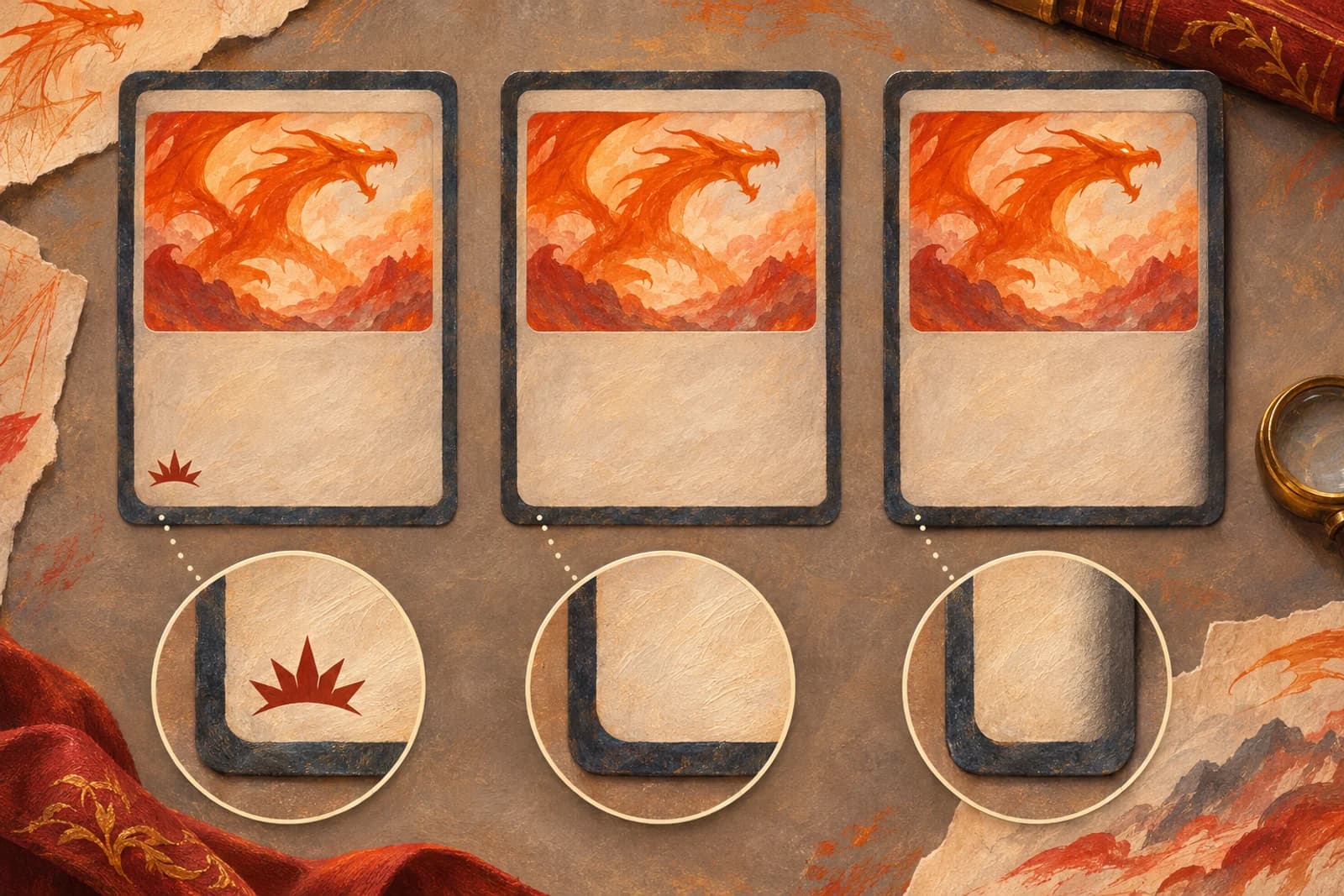
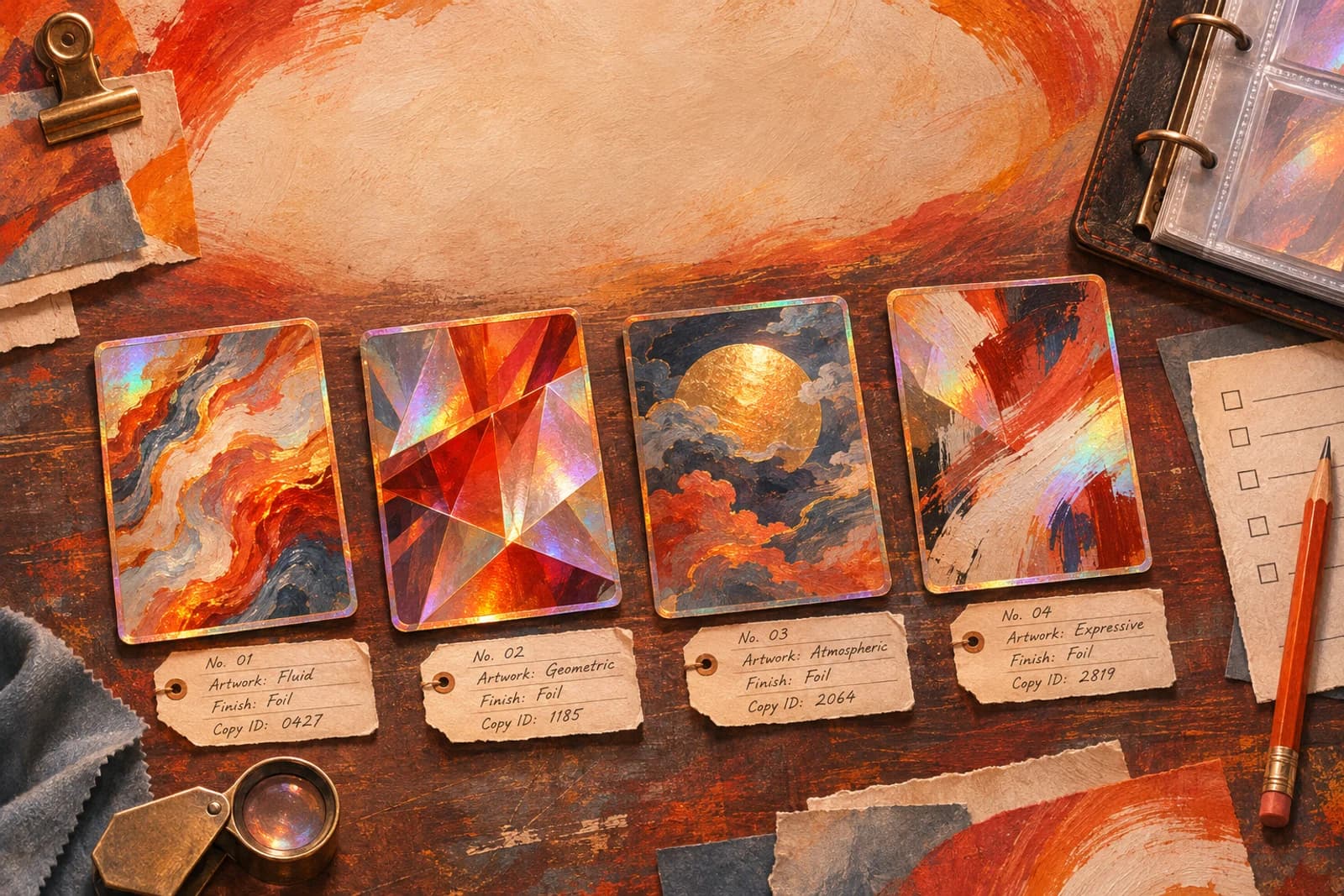
1. The seven versions behind one number
Look up Pre-Preparation of Rites in Konami’s official Yu-Gi-Oh! database and you’ll find seven entries dated November 3, 2023, all with the code RA01-EN055. Those rows aren’t duplicates: each names a different rarity from the 25th Anniversary Rarity Collection. The database also lists releases with other codes. So RA01-EN055 does useful work. It takes you from a card name that spans multiple releases to a particular release family. But it cannot take you the last step to a particular finish. If someone offers you an RA01-EN055 and you’re trying to fill a slot for one specific rarity, neither the name nor the code tells you whether to say yes.
Pokémon’s English Scarlet & Violet 151 checklist presents a different problem. Pikachu appears at 025 as a common and at 173 as an illustration rare. If you’re following the numbered checklist, they are two entries, not two finishes you can file under one number. Bandai’s English Romance Dawn list does almost the reverse: two Nami entries carry the same OP01-016 number and the same R rarity designation, but the entries link to different images. In the Pikachu example the number settles which checklist entry you’re looking at. In the Nami example even the number and rarity together leave a question that the pictures can help answer.
A photograph in The Strong National Museum of Play’s essay on the Pokémon TCG introduces a third kind of distinction. The museum identifies the object shown as a Wizards of the Coast Pikachu dated 2000 and credits it as a gift from Hugh Jones. That credit describes how the museum acquired the pictured copy. It does not give another owner’s visually identical Pikachu the same history. The essay places Pokémon’s 1996 Japanese launch in a genre that includes Magic’s 1993 release, but its individual photographs are selected collection objects, not a checklist of everything produced. What the museum knows about one object is valuable precisely because it doesn’t apply to every matching card.
When someone says they have “the same card,” ask what they need it for. A deck builder may be asking whether it counts as the same game card. A collector may be asking whether it fills the same want-list slot. A person looking through a binder after a move may mean the exact copy they put into a pocket last week. The clues that answer those questions differ:
| Identity | Useful evidence | Not enough on its own |
|---|---|---|
| Game card | Official game entry or the identity convention used by that game | A shared character or title |
| Printing | A matching checklist entry plus any art, finish or other detail needed to distinguish its versions | A shared number where the publisher lists several versions |
| Individual copy | A record tied to that object, such as a catalog ID and its own photos or acquisition record | Features shared by every copy of the printing |
Suppose two collectors are looking at the same pair of Romance Dawn Nami images. One has been using OP01-016 as shorthand for the game card and only needs to identify which card is on offer. The other already owns one version and wants the image shown in the other Bandai entry. A reply of “Nami, OP01-016, R” gets the first conversation further than it gets the second. For the second collector, a front photo clear enough to compare the artwork is a sensible next request. That comparison can distinguish the pictured designs; it does not tell either collector where the seller’s particular copy came from or whether it is authentic.
A name-first sort still makes a useful first pass. It gathers the Pikachus or the Namis so you can see where you have decisions to make. The trouble starts when the temporary group becomes the final catalog entry. If you mark “Pikachu” complete after putting 025 in a numbered 151 binder, your list can no longer remind you that 173 is a separate target. If you split every OP01-016 into a new game-card entry just because the art changes, your search for that identifier won’t bring the versions together. The mistake in each case is letting a shortcut meant for one job settle a different one.
You don’t need to investigate every visible difference before putting a card away. Work to the precision the task calls for. If a stack is for play, start with the relevant game identity. If an illustrated Nami slot is empty, compare the image. If an RA01-EN055 slot calls for a specific rarity, leave it open until you have evidence of the finish. And if two cards match at the printing level, there’s no need to invent a difference between them to keep track of which one you lent out. You need a way to point to the particular copy.
2. Three records your collection actually needs
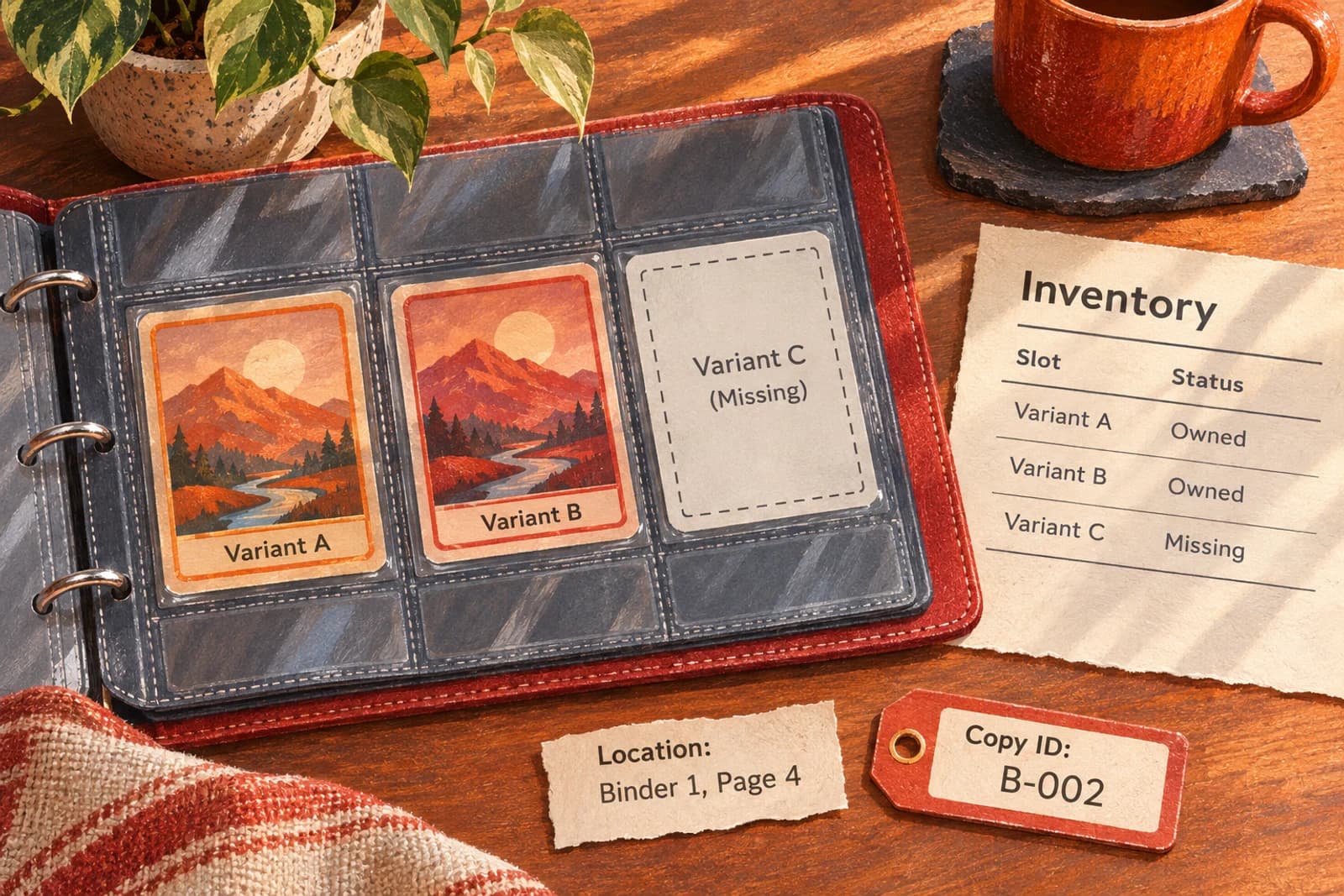
Give a game card, a printing and a copy separate records, even if all three are just tabs in a spreadsheet. One game-card record can link to several printings, and one printing can link to several copies. That arrangement lets you ask whether you own Nami OP01-016, whether you own a particular version, and which physical card you put aside for a trade without maintaining three conflicting answers in one cell. You can show a combined view when browsing the collection. What matters is that the row describing a printing does not have to be duplicated and rewritten every time you acquire another copy of it.
The game-card record holds the game, the official name and an identifier or link to the publisher’s entry or reference text. Use the game’s convention, not a rule imported from another publisher’s database. Bandai’s comprehensive rules, for example, generally key the One Piece four-copy deck limit to the card number, with a separate provision for effects that modify deck construction. Konami’s entry for Pre-Preparation of Rites, by contrast, brings multiple release codes together on one official card page. In both cases the game-card record gives the printings a common place to point. It isn’t a declaration that any specific version is currently eligible for every event.
The printing record describes a version someone could recognize on another copy. Enter the publisher’s set or product association and the exact identifier printed on the card. Add language, art, frame and finish as separate fields so a change in one doesn’t imply a change in the others. Record edition wording or a stamp when it distinguishes the version, and add a printed-wording state when you have evidence that it matters. If the publisher associates a version with a product, record that association here. A claim about the particular pack or collection yours came from belongs with the copy, and only if you have evidence for it.
Be deliberate about blanks. If a front image doesn’t show enough to identify the finish, enter “unverified,” not “nonfoil.” If the field doesn’t apply to that printing, mark it “not applicable.” And “no stamp visible” is an observation about the view you have, not necessarily a conclusion that the version was issued without a stamp. These distinctions pay off when you filter a spreadsheet. A search for stamp-free cards shouldn’t silently include every card you haven’t checked, and a search for unresolved finishes should still find the ones you put into sleeves months ago.
The copy record holds a local inventory ID, a link to the printing if known, condition observations and their supporting photographs, acquisition information if documented, and the present storage location. Imagine two copies that match the same printing description. One was received in a trade you recorded and has a visible nick on an edge. The other has no recorded acquisition history and its front photo shows no such nick. The documented trade and the condition notes belong to the copies. Neither the nick nor the absence of paperwork warrants a new printing entry. Nor does the second photo justify a blanket condition assessment of the whole card.
The National Park Service’s museum handbook offers a useful precedent: a catalog number assigned to an object is distinct from numbers already on it. Its cataloging guidance also separates identifying marks, design details and condition features, which helps prevent an observed scuff from ending up in the same field as a deliberate design element. Borrow the record structure, not the practice of applying an institutional marking to an object. For trading cards, keep the local ID in your inventory or on a removable sleeve label or divider rather than writing it on the card. If you replace a labeled sleeve, transfer the ID with the copy’s record.
A hypothetical intake shows why the separation matters even before you know what you have. A loose RA01-EN055 arrives with a legible front image but an uncertain finish. Link the copy to the game-card record and record the visible code as an observation. Keep the specific printing assignment pending instead of creating a new official-looking “unknown foil” variant or picking one of Konami’s seven rows by guesswork. If a later image resolves the finish, link the copy to the matching printing. The intake photo and the earlier note still document what was known at the time, and the copy keeps its original local ID.
There’s a cost to making three records: on the day you enter a single common card, one line would be quicker. Keep the extra fields proportionate to the collection. A simple numbered run might need only a few printing fields and a location for each copy; a collection that regularly compares variants needs more room for wording, finish and evidence. Before adding a field, ask whether its answer would change for another copy of the same printing. If it would, as with condition or storage, it belongs in the copy record. If it describes the version someone else could independently match, put it with the printing.
3. Pokémon: Why a binder called 151 runs past 151
Start with the legend on The Pokémon Company International’s English Scarlet & Violet 151 card list, not the number in the expansion title. The one-page sheet distinguishes standard entries from standard foil entries in its key. With that key in view, find Pikachu 025, labeled common, then find Pikachu 173, labeled illustration rare. Continue to the end and the final numbered entry is 207. Whatever filing system you use, “151” on the checklist title is the expansion’s name, not an instruction to stop at entry 151. If the binder is meant to follow the publisher’s numbered list, ending it there would leave out documented entries, including the second Pikachu.
Read the rendered sheet as a visual document. Use the legend to interpret the printed marks next to the entries, the number to identify the row, and the rarity designation to describe that row. Color in the legend is part of the key on the sheet; it is not a color sample for the border, ink or foil you should see on the physical card. A mark on the checklist can tell you how the publisher classified an entry there. It cannot tell you what a particular copy looks like at an angle, and the sheet does not enumerate every alternate finish, stamp or distribution variant a collector might choose to track.
In a numbered binder, 025 and 173 need distinct slots. The reason isn’t that one carries a higher rarity designation than the other. It’s that the unit being counted is a numbered checklist entry, and the publisher gives these two Pikachu cards different numbers. If you have two copies of 025, neither can fill the 173 slot, even if the second copy is in better condition or has a finish you prefer. Conversely, if 173 is the first Pikachu you obtain, put it in the slot you assigned to 173. Filling 025 with it would make the open pocket count look better while hiding the entry you still lack.
A Pokédex binder asks a different question: which Pokémon are represented? Imagine a collector who wants one representative card per species and has chosen 173 as the Pikachu to display. Their Pikachu slot is filled without 025. If they later prefer 025 in that slot, they can swap the cards without changing species coverage. Put those same cards back into a numbered checklist binder and the swap changes which entry is missing. A blank pocket in one layout stands for an unrepresented Pokémon; in the other it stands for a particular checklist entry. Both layouts make sense, but a gap in one is not evidence of a gap in the other.
For a copy in hand, the card itself supplies a separate set of clues. The Pokémon Company International’s December 2022 design announcement gave March 31, 2023 as the start of the Scarlet & Violet expansion launch and described a change from yellow to gray borders and from expansion symbols to expansion and language codes. The publisher’s English rulebook diagram for the newer layout labels the expansion code and collector card number separately. Look for both: the code tells you which expansion to compare against, while the collector number points you to an entry within that expansion. Don’t treat gray borders as a set identifier or assume that cards from older eras put the same information in the same place.
Consider a hypothetical trade photo cropped to Pikachu’s name and most of the illustration. If you are choosing a representative for a Pokédex display, that view may be enough to decide whether you like the art, assuming you still check whatever condition details matter to you. If you’re filling 173 in a numbered run, ask for an uncropped front or a legible image of the identifier area. Compare the expansion code and collector number with the English list before marking the slot filled. Check the language if your run is English only. A seller’s caption saying “Pikachu from 151” narrows the search, but it leaves open the very distinction the two checklist rows establish.
The binder title can keep the distinction visible. “Scarlet & Violet 151, English numbered entries” tells another person to account for the checklist through 207 and expect both Pikachu rows. “Pokédex, illustrated with cards from 151” tells them to look for one representative per species, if that is the rule you chose. Neither label promises every finish or stamps from every distribution channel. If you want to display extra copies next to a favorite illustration, you can do that without counting them as extra numbered entries or treating every unfilled spare pocket as a missing card.
To test the layout before moving anything, make two sample labels from the rendered checklist: Pikachu 025, common, and Pikachu 173, illustration rare. Then put an end marker at 207 on the numbered layout. On a separate sketch of a Pokédex page, give Pikachu one pocket and decide which of those labels you’d put there. Now imagine you own only 025. The numbered layout tells you exactly what to seek next if you want both entries; the species layout tells you there is no Pikachu gap to fix. That difference comes from what you chose to count, not from a discrepancy in the publisher’s list.
4. Pokémon: Build a second checklist for finishes and promos
Keep the publisher’s numbered list intact when you start tracking finishes. For the English Scarlet & Violet 151 checklist, make one baseline row per numbered entry and read the marks using the legend on the rendered sheet. Then open a second list for versions that need more description than the baseline provides. Link each version to its numbered entry where applicable. That way, identifying a new finish for a card you already own doesn’t create a new gap in the numbered run. It creates a target in the finish run, and only if that run is something you’ve chosen to collect.
Try the same exercise with the older English Platinum checklist, but don’t carry over assumptions from 151. The rendered Platinum sheet lists Lotad as both 81 and SH4. Enter those identifiers exactly as printed in the list, and give each its own baseline row. SH4 is not a finish annotation you should append to 81, and a spreadsheet that accepts only numeric identifiers will make one of the two entries hard to file. This is also a case where viewing the PDF matters: symbols and boxes on the sheet don’t all come through cleanly in extracted text. Use the visible layout when deciding which marks belong to which row.
Scarlet & Violet Black Bolt and White Flare require another kind of reading. The Pokémon Company International announced three parallel foil sets for each expansion, including Poké Ball and Master Ball patterns. That establishes that the named patterns belong in the vocabulary for those releases. The announcement is not a card-by-card inventory of every treatment, though. Don’t generate three finish rows for every number by multiplying the length of a checklist by three. To add a particular numbered card in a particular finish as a target, look for evidence of that combination, not just evidence that the card and the pattern both exist somewhere in the expansion.
A finish worksheet can be small: expansion, language, printed identifier, finish name, evidence and status. Suppose you have an ordinary copy of an entry and someone tells you there is also a Master Ball version. Start a research note rather than a missing-card row. A suitably clear image that shows both the identifier and the pattern on the same card would give you something specific to compare with the publisher’s description. A cropped image of a pattern alone doesn’t connect it to the number. If the only evidence you have is the general announcement, keep the proposed combination pending and out of your completion count.
Promos need their own product field because a product can contain cards that weren’t drawn from the boosters inside it. The split expansion’s product announcement names Snivy, Tepig and Oshawott promos for the associated Poster Collection separately from its booster contents. Imagine opening that collection and cataloging one of those named promos. Record the Poster Collection as the documented distribution route. If you personally opened the product and kept track of the card, you can also record that event for your copy. But don’t record it as a booster pull just because boosters came in the same package. The distinction affects where another collector would look for the card.
Decide how broad the promo list is before reserving pockets. You might include only the named promos in products you’ve explicitly listed, or you might keep all promos outside the expansion binder and link to them in your inventory. In the first layout, a labeled slot for one of the Poster Collection cards has a clear reason to be there. In the second, the same card’s absence from the expansion pages isn’t a gap. Declaring a promo scope is a filing decision, not evidence of a release: even an expansive scope doesn’t justify adding a rumored stamp or finish as though the publisher had documented it.
For a trial run, put one row from each of the three sources into your worksheet. Use a numbered 151 entry to test whether you can record the checklist’s designation without making an unsupported claim about an alternate finish. Use Lotad SH4 to test whether your baseline accepts letters as part of the identifier. Then use one named split-release promo to test whether you can record its product without assigning it to that product’s boosters. Give an unverified foil combination a research note and try filtering for missing cards. If the note appears in the results, your list is still mixing questions with targets.
A physical binder and a worksheet don’t have to show the same amount of detail. You can keep numbered cards in order at the front of the binder, then group confirmed parallels and in-scope promos behind dividers. Or you can place verified finishes beside their baseline entries for easier visual comparison. The first layout absorbs new attributions without moving the numbered run; the second makes comparisons easy but may require reshuffling. In either layout, reserve spaces only for identified targets. That keeps empty pockets useful: each one stands for a card you can describe, rather than a possibility generated by the spreadsheet.
5. Magic: Read the card's code, not just the box
Start a Modern Horizons 3 sort with the small code on the card, before deciding what goes behind the main expansion divider. Wizards of the Coast’s collecting guide distinguishes MH3 for the main set, M3C for Modern Horizons 3 Commander, H2R for select retro-frame reprints from Modern Horizons and Modern Horizons 2, and SPG for Special Guests. Those codes appear in the context of one commercial release family, but the guide doesn’t treat them as one numbered checklist. Record the card’s own code and collector number together. The box or booster name is useful for documenting the release family or an opening, but it doesn’t replace either part of that identifier.
Suppose you open a Modern Horizons 3 Play Booster and find a card with SPG in the identifier area. You know something about that copy’s origin because you opened the pack. You also know how to file it because the card supplies its code. Transcribe the collector number beside SPG, put the card in the Special Guests sequence, and, if you track acquisitions, note that you opened it in a Modern Horizons 3 Play Booster. Renaming the record MH3 would lose a visible clue. Filing the card under SPG without recording the opening would preserve its identity, but would leave out information you might want about that individual copy.
H2R is a particularly good check on whether your filing rules are doing what you intend. Wizards groups those cards as retro-frame reprints from both Modern Horizons and Modern Horizons 2 in its Modern Horizons 3 guide. In a hypothetical intake, a familiar name or older-looking illustration might send you to an earlier binder first. Read the actual code before you move the card. If it says H2R, use that code and its collector number in the printing record. You can link to an earlier version for comparison without entering the new copy as an original. The recognizable art, the reprint identification and the package it came from are separate pieces of information.
The same approach works when you didn’t open the product. Imagine a loose M3C card arrives in a trade, and the only acquisition record is the trade itself. Enter the printed M3C code and collector number and use the Commander association documented by Wizards. Leave the card’s original package unverified. A publisher’s guide can establish where a version was offered; a trade with no opening record doesn’t tell you which package supplied the card in hand. That difference lets you use the publisher’s information without turning it into a claim about a particular object.
If your shelves are organized by code, give MH3, M3C, H2R and SPG separate binders or independent sequences, depending on how much space each run needs. Within each sequence, file by collector number. A lookup for an SPG printing then takes you straight to the right sequence, even if you have material from more than one release in it. The tradeoff is that cards associated with a single product line won’t necessarily be on adjacent pages. Add a release-family field or index if you want to pull up those cards together without physically moving them.
If you prefer to browse by release, use one Modern Horizons 3 family binder with visibly labeled MH3, M3C, H2R and SPG subsections. Restart the numbering logic at each divider rather than interleaving numbers from different codes. In the SPG subsection, define whether you mean only the entries the Modern Horizons 3 guide associates with this release, rather than treating the shared code as a reason to include Special Guests from elsewhere. This approach keeps related products close together, but the divider labels and written scope have to do more work. A page marked simply “extras” won’t tell a second collector where to file the next card.
The tension between an expansion and its surrounding products predates Modern Horizons 3. In its 2019 account of Booster Fun, Wizards described separate alternate frames and specific product slots for Throne of Eldraine. Nonfoil special frames could appear in Collector Boosters, while a distinct alternate-art promo was associated with the bundle. For a collector, that history explains why a release name can be a useful umbrella without being a complete filing instruction. It doesn’t make Eldraine’s slot descriptions rules for Modern Horizons 3 or any other set. Use the guide for the release you’re sorting when recording where a treatment was offered.
Before labeling a binder complete, test its index with a hypothetical question from another collector: “Does this include the Special Guests from Modern Horizons 3?” If your scope is MH3 entries only, the answer can be no even if you opened several related SPG cards. If your scope includes the release family, the index should take the reader to the SPG subsection without making those cards part of the MH3 numbered sequence. Try the same lookup with an H2R card. If you can find both by code and number and still retrieve them by release family, the system supports either way of browsing.
6. Magic: Separate artwork, frame, finish and serial
A description such as “borderless concept Ulamog” tells you what to compare first, not everything you need to file the card. In its Modern Horizons 3 collecting guide, Wizards of the Coast describes the borderless concept versions of Ulamog, the Defiler and the other two Eldrazi titans, Emrakul and Kozilek. The guide lists nonfoil and traditional foil versions of the borderless concept cards, as well as serialized double rainbow foil versions. So a match to the concept illustration does not settle whether a copy is foil, and a borderless layout does not tell you which foil treatment you’re looking at.
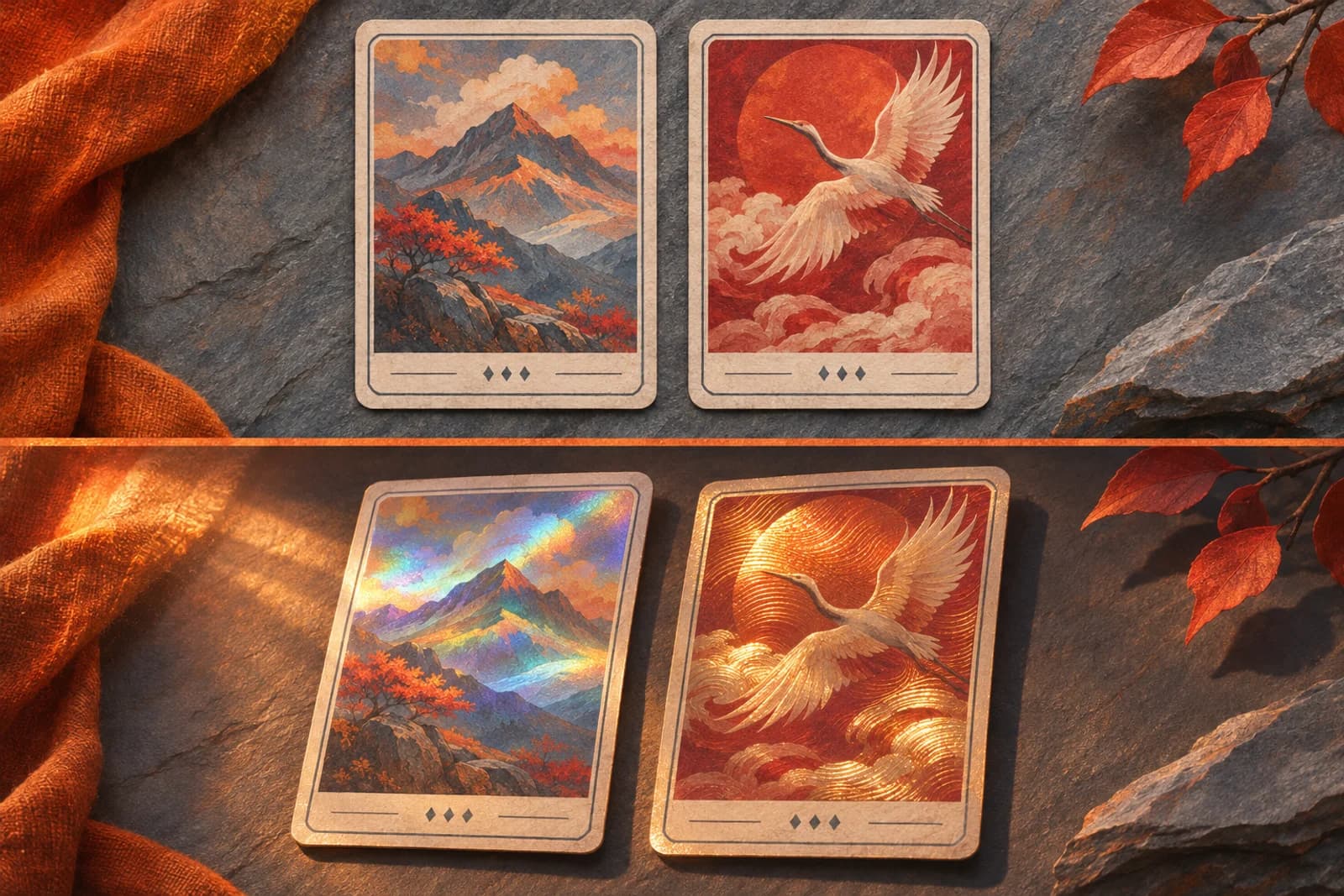
Give those clues separate fields. Use the art field for the concept illustration and the frame field for the borderless layout. Enter the finish using the publisher’s treatment name when the evidence supports it, and indicate separately whether the printing is serialized. Suppose a seller sends a straight-on photo that clearly shows the illustration and frame but leaves the surface looking flat. You can record the first two observations and ask for a view at an angle before choosing between nonfoil and a foil finish. A flat-looking image is not, by itself, evidence of a nonfoil card.
The collector number and an individual serial marking belong in different places. The collector number, paired with the set code, points to a catalog entry; it is not the number of the individual specimen in a serialized run. In the printing record, describe the version as serialized double rainbow foil if that is the supported attribution. In the copy record, transcribe the individual serial marking as seen and retain the image that supports it. If two specimens match the same serialized printing, their serial markings can differ without making their artwork, frame or finish different. Keep your local copy ID as well so you can track the object even while a marking is being checked.
Wizards states that each of the three titans has 250 English serialized double rainbow foil copies in Collector Boosters, with insertion across pack languages. The pack-language detail matters: a Collector Booster in another language is not a reason to reclassify the serialized card as a version in that language. Record the card’s language from the card and the pack language from the pack if you have that evidence. The figure of 250 per titan is Wizards’ stated quantity for that specific English serialized treatment, not a count of all borderless concept copies, all foil copies or copies now held by collectors.
Treat traditional foil, textured foil and ripple foil as named treatments, not interchangeable descriptions of a reflective surface. The collecting guide uses traditional foil for versions of the borderless concept Eldrazi and identifies ripple foil as a treatment of the Collector’s Edition Commander decks. Its use of textured foil elsewhere is not permission to apply the term whenever a photo appears to show texture. Check that the guide connects the proposed treatment to the card or product you are cataloging. If the only thing you can observe is that the surface reflects light, put that in the observation field and leave the treatment unverified.
Wizards labels the ripple foil illustration in its guide as a digital render rather than an actual card. Use it to understand which treatment the publisher is describing and where the guide places it. Don’t use it as a photograph of how a particular specimen reflects light, or as a condition benchmark for a copy. A listing photograph may show a real card from a useful angle, but only use it for details the image actually makes visible. For example, an angled image that shows the surface might obscure the small identifier or marking; a second, legible image can answer that different question.
Consider a hypothetical Ulamog listing titled “borderless concept, numbered foil.” The front image lets you compare the art and frame and read a collector number, but it leaves the claimed serial area unclear. Ask for a close view that shows the individual marking in context and an angled view if the finish is still in question. In the meantime, record the collector number where it belongs and keep “numbered foil” as the seller’s description, not a verified attribution. This follows the distinction in the National Park Service’s cataloging guidance between identifying marks, design details and condition features: record what you can see before deciding what it means.
The evidence you need depends on the pocket you’re filling. For a display that calls for the concept illustration in any finish, a clear match to the art, frame and printed identifiers can be enough to settle whether the version fits your scope. A slot labeled “traditional foil” calls for evidence of that treatment; a serialized slot calls for evidence of the marking as well. If you already cataloged a copy before its finish was resolved, update the printing link when better evidence arrives and retain the earlier observation. There’s no need to assign a new copy ID, and no reason to let a better photograph rewrite what was known at intake.
7. One Piece: How to file a PRB-01 Nami with an OP01 number
Put Bandai’s English Romance Dawn and One Piece Card The Best checklists side by side and search both for OP01-016. The Romance Dawn page has two entries named Nami, both numbered OP01-016 and both designated R, with different images. The premium booster page lists Nami under OP01-016 as obtainable in PRB-01. The name and card number agree across the two product lists. The product headings do not, and they don’t need to: PRB-01 is the name of a later distribution route, not a replacement for the number printed on the card. Transcribing the number as PRB-01 would make the inventory harder to check against either list.
To compare the entries, start with the names and numbers, then open the images linked from the individual rows. Note which illustration each row shows rather than treating the first search result as the default Nami. In Romance Dawn, the R designation won’t break the tie between the two images. Likewise, finding OP01-016 in the PRB-01 list tells you that the number occurs in that product, but it doesn’t make every OP01-016 a match for the version pictured there. The product page gives you a reference to compare against. It doesn’t do the comparison for you.
Imagine a loose English Nami comes out of a mixed collection with no wrapper or opening record. The name and number are legible, and the artwork is clear enough to match the image linked from Bandai’s PRB-01 entry. Record that specific image match and the checklist that supports it. If the photograph doesn’t resolve a finish or another feature your binder uses to distinguish versions, leave that feature pending. Most importantly, record the original package of the loose copy as unknown. You can say its pictured design matches the PRB-01 listing without saying that the copy was pulled from PRB-01. The first statement is a comparison you can show someone; the second describes an event for which you have no record.
A separate acquisition note might say that you received the card in a mixed lot. That’s useful history even if it takes you no closer to the original booster. An opening record tied to the individual card would answer a different question, while a photograph of a wrapper lying next to a loose card would not, by itself, show they came together. The National Park Service’s cataloging guidance distinguishes design details from identifying marks and condition features. Apply that discipline to the evidence here: keep the illustration comparison with the description, and don’t turn either the printed number or the seller’s account into an observation it can’t support.
A number-first binder makes the comparison easy to revisit. Put the OP01-016 versions together and label the pockets using the distinctions you can actually describe, such as the art shown in a particular checklist row. A note in the index can point to both Romance Dawn and PRB-01. If another collector asks which Nami versions you have under that number, you can show them one group. The tradeoff is that you cannot tell at a glance which entries you still need for a PRB-01 run. For that, filter the inventory by documented product association rather than counting everything on the Nami page.
A product-first binder works the other way around. Let Bandai’s PRB-01 checklist define the section, then require a match to the relevant entry before using a copy to fill its pocket. Keep OP01-016 on the label so the card remains findable by its printed number. If the goal is to represent what the premium booster offered, a supported version match can fill the slot even when the original wrapper is unknown. If your goal is a binder of cards you personally opened from that product, the same copy doesn’t qualify without an opening record. Writing that rule on the divider prevents a checklist match from quietly becoming a claim about the binder’s contents.
Now suppose the only photo for a second loose copy shows the number and rarity but cuts off most of the artwork. You can file it provisionally under OP01-016 in the number-first system, but you can’t choose the art-specific pocket yet. In a product-first system, don’t put it into PRB-01 just because the number turns up in that checklist. Ask for an uncropped front and compare the image again. If the new view resolves the art but not the distribution of that individual copy, update the art field and leave the origin field alone. A clearer photo can improve one attribution without improving the other.
A useful binder index can answer three questions about either loose card without forcing a single label to do all the work: What number is printed on it? Which publisher image does it match? What do you know about where this particular copy came from? For the first hypothetical Nami, the answers are OP01-016, a match to the PRB-01 checklist image, and no documented original package. For the second, the number is known but the image match is pending. Those are two usable records, even though neither gives you a complete history of the card.
8. One Piece: An errata date is not a print date
Bandai’s February 17, 2023 errata entries for Nami OP01-016 show old and corrected wording for both the regular and parallel versions. The old wording calls for one eligible Straw Hat Crew Character card. The corrected wording says up to one eligible Straw Hat Crew card, dropping the Character restriction. The quantity change helps identify which wording is on a copy, but it doesn’t date when the selection became optional in play: on November 11, 2022, Bandai had already told players to read the selection as up to one for both versions. Neither wording change gave Nami a new card number.
For an exact comparison, first confirm that the copy says Nami and OP01-016, then match its illustration to the regular or parallel reference. Next, read the selection clause itself. Check whether the quantity says one or up to one, and separately whether the eligible card is specified as a Character card or simply a card. Compare both details with the same before-or-after example in Bandai’s notice. If one detail is readable and the other is hidden by glare or too small to make out, record the visible detail and request a better view. Don’t upgrade a partial match to a confirmed wording state just because the listing calls the card pre-errata.
For example, imagine a listing with a front image clear enough to match the parallel artwork, but with the effect box washed out. The seller calls it an original-text parallel. Put the art match in the inventory and the wording claim in a note attributed to the seller. Ask for a straight-on crop that shows the entire effect box, not just a close-up of the card number. If the new image lets you read both the original quantity and the Character restriction, you can record an old-wording match. If it shows the corrected quantity and no Character restriction, record a corrected-wording match and retain the image that explains why you disagreed with the description.
Keep that comparison separate from the official effect you use to play. One field can record the wording state visible on the card, supported by a photo or a short transcription of the identifying clause. Another can point to Bandai’s official correction. That way, an old-wording copy remains accurately described without presenting the old wording as an alternative effect. Conversely, copying the publisher’s corrected reference text into the field meant for the physical card would conceal the very difference you’re tracking. Bandai’s Romance Dawn entries link to errata, but the displayed reference text is not evidence of what any particular copy says.
The date beside Bandai’s notice tells you when the correction was documented there. It does not tell you when a loose copy was produced. Bandai specifically says in the notices accompanying the Nami entries that the production date cannot be determined from the product packaging. A sealed box therefore does not give you the date evidence you need to assign a wording state to an unseen copy. Even after an opening, finding corrected wording answers the text question, not the exact production date. And a PRB-01 checklist entry establishes a distribution route for the listed version; finding a familiar number on that list does not substitute for reading the copy in front of you.
Consider two people inspecting the same cards. One is preparing a deck and has regular and parallel copies of OP01-016, with both wording states represented. Bandai’s comprehensive rules generally apply the four-copy limit by card number, with a separate rule for effects that modify deck construction. The deck builder counts those Namis together under the general rule and uses the official corrected effect. Having four with old wording and four with corrected wording doesn’t yield eight slots. The other person is building a printing collection and may give the two documented wording states different slots within an art grouping. Neither person needs to change the underlying game-card identity to make their count work.
If the words visible in a photo don’t match either side of Bandai’s correction cleanly, describe the discrepancy before trying to explain it. A hypothetical image in which up to one seems legible but the card-type phrase is cut off goes in the unresolved pile, not in a third wording category. If a clearer image still appears inconsistent, compare it against the correct entry for that artwork and keep a review note. A genuine-looking difference in one phrase is a reason to investigate; it isn’t enough to name a new printing, assign a production sequence or make a claim about how many exist.
For a binder that tracks the distinction, a useful pocket label pairs the art reference with the wording state, such as parallel artwork, old wording. The notes behind that label should tell another person what to check: the number, the image, the quantity phrase and the presence or absence of the Character restriction. Leave a production date blank unless you have separate evidence for it. That gives a future buyer or trade partner something firmer than a label like early print: they can inspect the two relevant parts of the effect text and decide whether the card fills the intended slot.
9. Yu-Gi-Oh!: Build a seven-row want list from RA01-EN055
Set up the want list with Pre-Preparation of Rites and RA01-EN055 in every row. In Konami’s English card database, the seven entries with that code share a November 3, 2023 date, while other releases of the same card have other codes. Start your search with the name and code together so a correct card name from a different release doesn’t slip into the list. Then give the rarity its own column. Konami describes the 25th Anniversary Rarity Collection as 79 cards offered in seven foil rarities each, so ticking a single box marked foil would collapse every version you are trying to distinguish.
Make one row for each of Konami’s rarity labels: Super Rare; Ultra Rare; Secret Rare; Platinum Secret Rare; Collector’s Rare; Ultimate Rare; and Quarter Century Secret Rare. Konami’s product guide describes the Collector’s Rare and Ultimate Rare treatments in this release as Prismatic Collector’s Rare and Prismatic Ultimate Rare. Keep the database labels in the rows and, if useful for searching, put the fuller product terminology in an alias field. Do not create extra rows for those alternate names. Likewise, don’t shorten Platinum Secret Rare or Quarter Century Secret Rare to Secret Rare in the identity field. That would make three separate entries look interchangeable when you filter your list.
Before shopping, decide which columns are part of the target and which describe the copy you’d accept. For a rarity run, the card name, RA01-EN055 code and full rarity name define each target. An edition requirement, if you have one, should be stated separately. Put your condition preference in another field so that a copy with the right finish but more wear than you want doesn’t end up categorized as the wrong printing. If you only intend to own one example of RA01-EN055 in any finish, you can keep the seven rows as a reference and mark that broader goal satisfied by one supported match. There’s no obligation to hunt for the other six.
A clear, straight-on front photo is the first useful check. It can show whether the name and the whole set code are what the listing claims, and whether edition wording is readable when that matters to your target. Depending on the photograph, it may also show enough of the reflective design to support the rarity description. But a bright patch can conceal the pattern, and a head-on view in diffuse light can make different surfaces look deceptively similar. When the finish is the remaining question, ask for an angled front view that still shows enough of the layout to compare it with the straight-on image, rather than a tightly cropped patch of shine that could belong to another card.
Check the two kinds of evidence in order. Suppose a seller titles an item Quarter Century Secret Rare and the front image clearly reads RA01-EN055, but the reflection gives you no usable view of the treatment. The code agrees with the release, not with the proposed rarity specifically. Keep the row open and ask for an image that answers the finish question. If the seller supplies an angled view but the set code is out of frame, the two images should still give you reasonable grounds to connect the views. You’re checking whether the visible card fits your target, not establishing authenticity from the appearance of its foil.
One consulted listing offers an ungraded RA01-EN055 as a 1st Edition Secret Rare and includes front and back images. The title supplies a candidate for the Secret Rare row, not the Quarter Century Secret Rare row. Both rarity names appear in the official database, so the fact that the shorter term is contained in the longer one doesn’t make it shorthand for that treatment. Nor does the seller’s condition description independently establish condition. Use the listing as an example of how to specify the card in a search or a trade request, then check what the photographs actually support. Nothing about the listing establishes a price benchmark or future availability.
If edition is part of the request, don’t accept the security foil as a substitute for reading the edition wording. Konami’s identification guide describes gold security foil for both First Edition and Limited Edition. And a gold security foil is not what turns a listing into a Quarter Century Secret Rare. Imagine the seller replies to a finish question with a close-up of only the bottom-right security foil. That photo may document the appearance of the security mark, but it leaves the treatment of the rest of the card unanswered. Ask for the view you actually need, or keep the rarity unverified.
Write the open request so the other person can answer it without guessing: Pre-Preparation of Rites, RA01-EN055, Secret Rare; First Edition if required; please include a readable front and an angled view if the foil pattern is hard to see. For a Quarter Century Secret Rare slot, change the rarity explicitly instead of adding a vague qualifier such as premium foil. Keep a candidate listing attached to its row without marking the card owned. The test is whether someone can tell from the request which other versions with the same code would be acceptable, and whether the images they send answer the question that kept the slot open.
10. Yu-Gi-Oh!: Password, edition and security foil answer different questions
Read a Yu-Gi-Oh! card in an order that keeps the most useful identifiers from getting crowded out by the smallest marks. Start by transcribing the name and the complete set code. For Pre-Preparation of Rites, RA01-EN055 takes you to the relevant group of release rows in Konami’s database; a match on the name alone would also bring up releases with other codes. Preserve the letters, digits and hyphen rather than reducing the code to 055. If a sleeve edge obscures part of it, note which characters you can read and check the rest before assigning a release. Searching a partial code can help you find candidates, but the result is not a transcription of the card.
Next, read the edition wording itself. If the card says “1st Edition,” record it that way in the observation field. A normalized label such as “First Edition” can sit alongside it for filtering. Do the same for “Limited Edition” when that is what you see. Distinguish wording that is not visible because a photo cuts off part of the card from wording you have looked for and not found in a complete, legible view. These are different notes, and neither calls for quietly filling the edition field with a seller’s guess. For an edition-specific want list, legible wording is more useful than a general assurance that the card is an early copy.
Now record what supports the rarity or finish attribution. Name the treatment if you can match it to a Konami release row and the card provides enough visual evidence. If all you can tell is that part of the card reflects light, describe that observation without choosing a rarity. In particular, the reflective mark in the bottom-right corner is not a sample of the treatment elsewhere on the card. A close-up that makes that corner easy to read can be excellent evidence for the appearance of the security foil and useless for distinguishing the finishes sold under RA01-EN055. Keep each observation attached to the part of the card it describes.
Only then copy the small numerical password, if present, and note the security foil separately, where applicable. Konami’s identification guide locates the password on the bottom left of many cards and the security foil on the bottom right. The password is not an alternate spelling of the set code. Even when you can read the password and use it alongside the card name, you still need the set code to identify the relevant release. And Konami describes gold security foil for both First Edition and Limited Edition, and silver for Unlimited Edition. The guide gives you a way to compare an observed mark with an edition claim. It does not make gold a way to choose between the first two editions.
Suppose one hypothetical listing says “gold stamp” and shows only a legible name and the bottom-right corner. The seller’s reply that gold means First Edition doesn’t resolve the edition. Ask for a straight-on view that includes the edition wording and enough of the card to connect it with the listing, preferably with the set code readable as well. If that view says “1st Edition,” you have evidence of what the pictured card says. If it still doesn’t show the code, you have not verified the release. If the seller sends a sharper photo of precisely the same gold corner, nothing has been added on either point.
A second hypothetical listing also says “gold stamp,” but its full front clearly reads “Limited Edition.” Record Limited Edition for the pictured card, with gold security foil as a separate, consistent observation under Konami’s guide. If the seller has selected First Edition in a listing menu, note the conflict rather than averaging the two descriptions into “gold edition.” A collector with a First Edition slot can rule out the pictured version on the strength of the visible wording. A collector looking for Limited Edition may still need to establish that the code matches the release they want and that the surface is the advertised rarity. The same gold color settled none of those questions in either listing.
This is a useful place to apply the National Park Service’s distinction between identifying marks and design details. Give the edition inscription, password, security foil and rarity their own fields rather than storing them in a single note labeled “markings.” If an observation and a description disagree, keep both with their origins: for example, edition wording from the front image and edition claim from the seller’s title. A later photograph can then resolve a specific conflict without rewriting the original evidence. Even a fully consistent set of observations is a description of what the card or its images show, not an authentication test. Use it to decide whether you’re looking at the intended version and whether another view is worth requesting.
11. Preserve the words on the card without mistaking them for the rules
A text field labeled “effect” can quietly acquire two jobs. It might be a record of the words printed on a physical card, or it might tell someone what text to consult when playing. Those jobs use different evidence. The physical record starts with the card or a legible image of it. The gameplay record points to the publisher’s reference. Give them different labels so that importing a publisher update does not overwrite an observation about an object. Equally, do not use a transcription from an older card to replace the reference a deck builder consults. The usefulness of the catalog depends on being able to see both answers.
The publishers document that distinction in different ways. Bandai’s Nami notice puts old and corrected language side by side, so it can serve as a reference for identifying a wording state as well as documenting the correction. Wizards of the Coast describes Oracle as the official wording for Magic and directs readers to Gatherer. A historical Wizards update bulletin explains how a change was recorded; for current wording on an individual card, follow the reference rather than treating the bulletin as current. Konami’s Pre-Preparation of Rites page supplies card text separately from the release rows. Those rows let you compare release codes and rarities, but the presence of one text block on the page does not independently establish every word visible on every version.
Transcribe only what you need when a short phrase reliably locates the difference. A field such as “printed wording excerpt” can hold the identifying words, with a locator like “selection clause” so another person knows where to look. Keep capitalization or punctuation as seen if either is the point of the comparison. Do not silently fix something that appears odd, and do not type words from the official entry to fill a gap in the photograph. A short excerpt is easy to search, but it can lose context. If the difference depends on surrounding words, the line break, or which part of a long effect the clause belongs to, retain a photograph of the whole text area and use the note to direct readers to the relevant spot.
For gameplay, one link at the game-card level is usually more useful than copying the same official text into each finish or edition row. That avoids a spreadsheet in which some rows get updated and others still show stale language. When a correction matters to a printing, retain the relevant notice with that printing’s evidence as well. Record what each reference is for: the gameplay entry is where to consult the official text; the dated notice is what supports an attribution to a documented wording state. A short transcription, a photograph and a reference link can all belong in the same catalog without any one of them standing in for the others.
Imagine three photographs offered as evidence that a Nami OP01-016 differs from the text on Bandai’s card page. In the first, you can verify the card number and artwork, and the entire relevant clause matches the old wording in Bandai’s notice for that version. Assign “documented correction” and specify that the depicted copy carries the old wording. That status says why the difference is recognized. It does not assert when the object was made or add a new game-card entry. Keep the photograph so the attribution can be checked even if the seller removes the listing or the live reference page is updated.
In the second photograph, the clause is legible, but after checking the correct language and artwork you still see a phrase that does not fit either wording in the notice. Mark it “apparent difference requiring review,” transcribe the phrase, and ask for a full front and a second view of the text. Check that you are comparing the same clause in the same language before calling it a distinct wording state. In the third photograph, a bright reflection hides the crucial phrase. Mark it “not readable from available evidence.” That is not a weaker claim that the text is different. It says you cannot yet make the comparison. Both records can stay usable for other purposes while the text question is open.
Keep format eligibility out of this decision. A card’s title or corrected wording does not tell you whether a particular version is allowed in an event today. Nor does a historical rules document settle that question: the English Pokémon rulebook used to identify elements of a card layout, for instance, is not a current tournament legality reference. If the collection is also used to assemble decks, put eligibility in a separate, dated note tied to the format or event guidance you checked. Then a rules update can change that note without changing the printing description, and a better photograph can change the wording attribution without giving the copy any new claim to eligibility.
12. Photograph the question you need to answer
For a copy you need to document, begin with a straight-on front and back in even light. Include the whole card and all four corners in each view. The front puts the name, artwork, layout and identifier area in relation to one another. The back records the side that a front-only listing leaves out and gives you another view of the perimeter. Keep the two files together under the copy ID. A tight image of a corner can be useful later, but it should not be the only view of that side. Without the full frame it is harder to tell where the detail sits or to connect it confidently to the card you cataloged.
Add a crop or close photograph of the footer when the question is what the card actually says in small print. Keep enough surrounding layout to locate the detail, and check the image at the size at which someone will read it. If the question is a set code or a collector number, the relevant characters must be sharp, not merely present in the frame. When the text of interest is elsewhere, such as a clause in an effect box, move the close-up there. If you make a crop from the full front, keep the original too. It supplies context and lets you revisit a nearby mark later without relying on how you framed the first question.
For a foil pattern or texture, add an angled view instead of replacing the straight-on one. A flat image can make a reflective treatment hard to see; tilting the card relative to the light may bring the pattern into view. A bright reflection can also hide a scuff or wash out the art under it. If that happens, use a second angle or return to an evenly lit image for the condition question. Keep a recognizable part of the layout in the angled view so that it can be compared with the full front. An isolated bright patch is difficult to connect to a printing and even harder to connect to an individual copy.
Write condition observations as descriptions of what the image shows. If a hypothetical back photo reveals a thin line near the lower edge, note where it is and which file shows it. Do not call it a factory error or attribute it to handling on appearance alone. If the picture was taken through a sleeve, a further view may help establish whether the line is on the sleeve or the card. Until then, say where the line appears in the image, not where you have proved it is. The National Park Service’s cataloging guidance is useful here because it separates identifying marks, design details and condition. PSA’s grading standards likewise identify features such as centering, corners, focus and gloss, but a photo note about one of those features is not a numerical grade.
Record whose image you are looking at and what it depicts. Wizards of the Coast labels the Modern Horizons 3 guide’s ripple foil illustration as a digital render. It can help you identify the treatment the guide is discussing, but it cannot show wear or the response of a physical specimen to light. The Strong’s photographed Pikachu, by contrast, documents a particular museum object. It can be useful for comparing a visible design feature, but the photo and its credit still refer to the museum’s copy. Neither image belongs in a field meant to show the present condition of your card. Label reference images as references even when they are sharper than any picture you have of the copy under review.
A seller image serves a third purpose: it helps you decide what to ask about the item on offer. The consulted listing for the Secret Rare Pre-Preparation of Rites includes front and back images, but the existence of two views does not certify the seller’s rarity or condition description. Suppose a listing for a copy you want shows a sharp code and an evenly lit back, but the finish is indistinct. Request one angled front that keeps part of the layout visible, rather than asking for another entire set of pictures. If instead the finish is visible and a reflection hides an edge you care about, ask for that edge without the glare. The missing evidence, not the number of files, should determine the request.
Retain the original files even if you also make annotated crops or smaller images for the inventory. Link each derivative to its source and note whether the image came from the publisher, the seller or your own documentation of the copy. For example, a crop made to read a footer can sit next to a note transcribing the code, while the uncropped front and back remain the baseline views. If a later picture shows a feature more clearly, add it with the date and the question it resolved rather than replacing the older file. You can then tell a better view of an existing feature from a change in the object’s condition, or leave that distinction open if the earlier photograph never showed the area clearly enough.
13. A slab label is a claim you can cross-check
A slab gives you three things to compare: the wording on the physical label, the record returned by a certification lookup, and the card visible inside the holder. Start by asking which of those three actually names the version you want. A label may name the card and set without specifying the finish. A lookup may supply a more detailed description than the label, or it may repeat the same broad identification. The card may show the decisive feature, but the available photograph may not. Agreement on the name is useful evidence; it is not agreement on a variant that none of the three sources clearly identifies.
Transcribe the label as it appears, including the grade, certification number and any abbreviations. If you expand an abbreviation for searching, put the expansion in a separate field rather than making it look as though the grader printed it. Record the lookup result separately, with the date you checked it. Compare the card name, set, printed code and specific variant wherever those details are actually present. A set name on the insert and a code on the card can be consistent without being identical text. Conversely, if the lookup and label use different variant terms, preserve both until you establish whether they refer to the same treatment.
Suppose you’re assessing a hypothetical slabbed Pre-Preparation of Rites for a Quarter Century Secret Rare slot. The label names the card and the 25th Anniversary Rarity Collection but gives no finish. The lookup repeats that description, and a straight-on photograph shows RA01-EN055 on the card. Those pieces support the release identification. They don’t settle the rarity: Konami lists seven rarities for that code. If the seller calls it Quarter Century Secret Rare, save that as an attributed claim, not as information supplied by the grader. In this case the label isn’t necessarily wrong. It simply stops short of the distinction your want list requires.
What would move the record forward? Ask for an angled photo of the card inside the holder, with enough of the face or label in view to connect it to the straight-on image. If that view supports a finish identification, attach the finding to the card observation and leave the literal label transcription alone. If the angle mainly shows glare from the holder, retain the broader release match and leave the finish unresolved. You can keep an owned copy in inventory under its existing ID without linking it to one of the seven printing rows. If it’s a purchase candidate, the want-list slot remains open.
Treat an omission differently from a conflict. If neither the label nor lookup specifies a finish, flag the missing detail when it affects a decision, such as whether to count the copy toward a finish run. If the lookup explicitly says Secret Rare while the label explicitly says Quarter Century Secret Rare, flag a conflict even if your binder accepts either one. Those are separate Konami entries, not interchangeable descriptions. PSA acknowledges that data-entry errors can produce discrepancies between a label and its database. That makes an administrative explanation possible, but it doesn’t tell you which description, if either, is right in a particular case.
Grade belongs beside the grader’s name and certification details, not in the field that identifies the printing. A numerical grade won’t settle which finish is in the holder, and a finish match won’t validate the grade. PSA’s standards consider factors such as centering, corners, focus and gloss, and they also describe circumstances in which PSA declines to assign a numerical grade. If a hypothetical photo shows a pale spot near a corner, record its location and that it was seen through the holder. The image may not distinguish a feature of the card from a reflection or mark on the plastic. It isn’t a basis for predicting a PSA grade or regrading the card yourself.
A successful lookup also answers a narrower question than the word “verified” can suggest. PSA warns that a genuine certification number can be copied onto a counterfeit insert. A matching online result tells you that PSA has a record for the number and that the fields you compared agree. It does not prove the pictured holder or enclosed card is genuine. If a listing shows only the certification number and a stock image of the card, a lookup cannot establish what is in the holder being offered. Leave the image comparison unperformed rather than counting the number and the database result as two confirmations of the physical item.
For the hypothetical omitted-finish slab, a useful entry would say that the label and lookup name the release without a rarity, that the card photo shows RA01-EN055, and that the advertised finish remains unverified. Store those findings alongside the recorded grade without turning the grade into an identity endorsement. If a later image resolves the finish, date the new attribution and retain the earlier note. If the grader later corrects the label or database, record which changed. Another collector reading the inventory should be able to tell whether a conclusion came from the card, the insert or the lookup, even after all three agree.
14. Rarity, pack frequency, print quantity and graded population
A rarity name tells you which category a publisher assigned to a card or treatment. Its frame of reference is the publisher’s documented set or product lineup, not a denominator of physical copies. In Konami’s 25th Anniversary Rarity Collection, the publisher describes 79 cards offered in seven foil rarities each. That describes the range of named card and finish combinations. It doesn’t say those combinations were printed equally often. If your worksheet asks how many finishes are documented for a card, seven is the relevant total for that product. If it asks how many copies exist in one of those finishes, the same number does no useful work.
Konami’s pack guide does give chances, but the unit matters. Its upgrade descriptions apply to specified Secret Rare and Ultra Rare slots. The denominator for one of those statements is opportunities in the specified slot, not every card in the booster, every pack across the Yu-Gi-Oh! line or every copy of a named card. If a pack has multiple opportunities, a slot rate also isn’t automatically the chance of seeing at least one upgrade in a whole pack. Keep the publisher’s unit intact when recording the figure. Label a slot rate as a slot rate rather than using a column headed simply “pull odds.”
Dividing an upgrade rate by the set’s 79 names would assume that all 79 belong to the eligible pool for the particular draw and that every eligible name appears with equal probability in that slot. To estimate the chance of one named card in one named finish, you would also need to know whether the quoted rate applies to that finish specifically or to a group of possible upgrades. Imagine a collector whose target is Quarter Century Secret Rare Pre-Preparation of Rites. Konami documents that the combination exists. The product’s upgrade description, by itself, does not give that collector the chance of pulling that exact combination.
Wizards of the Coast’s Modern Horizons 3 guide uses another unit when it gives frequencies for Special Guests in Play Boosters and Collector Boosters. Read each statement against the booster type it names. A figure for Special Guests in a specified booster describes the publisher’s stated frequency for that group in that product, not the frequency of a particular Special Guests card and not the fraction of all Modern Horizons 3 cards that carry the SPG code. When comparing the two figures, put the product names beside them. Applying either number to an unsorted pile of boosters from both products would ignore what was actually counted.
A declared print quantity answers a different question from either kind of frequency. Wizards states that each of the three Modern Horizons 3 Eldrazi titans has 250 English serialized double rainbow foil copies. The count is in copies per titan for that specific treatment. It does not include the corresponding nonserialized cards, and insertion across pack languages does not turn it into 250 copies per language. The number also doesn’t tell you what fraction of Collector Boosters contains a particular titan. For that calculation, a declared quantity by itself supplies neither the total number of eligible boosters nor the distribution of copies among them.
A PSA population figure is a recorded count from one grader. Read the category and grade you’ve selected before using it: a count at one grade is narrower than a total across grades in the category, and neither count includes ungraded cards or the records of other graders. Add the date of the lookup if you save a number. You are preserving what the report showed in the selected category, not measuring what was manufactured or what remains in collections. Even for a treatment with a publisher-declared quantity, the population report is not a census of the surviving copies.
Imagine that collectors kept a foil variant raw for display, so relatively few owners sent it to PSA. Its population could look small even if raw examples circulated regularly. Now imagine instead that the grader began distinguishing the variant only after earlier submissions had already been classified more broadly. The newer category could start with a low tally without anything having changed about the physical cards. PSA describes both limited submissions and late recognition as ways population data can underrepresent a variety. Neither explanation establishes what happened for a particular card. A low figure can prompt a question about the record; it cannot answer that question unaided.
Try rewriting a note that says “rare because few are graded.” For a population lookup, write “PSA reported this count in this category at this grade on the date checked.” For a pack guide, write “Konami describes an upgrade chance for this slot” or “Wizards gives a Special Guests frequency for this booster type.” For the Eldrazi figure, write “Wizards states 250 English serialized double rainbow foil copies per titan.” Those sentences say who supplied the figure and what it counted. None needs an extra conclusion about surviving supply, market value or whether the card will be available when you look for it.
15. Put a boundary around the words 'complete set'
Before you calculate completion, write a rule that lets someone else decide whether an offered card fills a slot. “Complete 151” doesn’t tell them whether they can send any copy of Pikachu 025, whether you need a specific finish or whether a promo from an associated product counts. A title such as “English Scarlet & Violet 151, one copy per numbered entry on the publisher checklist” does. Keep that rule with the checklist rather than relying on a binder cover, and identify which version of the checklist you used. If you later change the project, keep the earlier rule with any completion figures you recorded under it.
For a numbered run, state how you count the entries in the named release. The English 151 list runs through 207, so one slot per numbered entry includes both Pikachu 025 and Pikachu 173. Another copy of 025 doesn’t replace 173, and an alternate finish of 025 doesn’t create a second requirement if any eligible finish will do. For the 25th Anniversary Rarity Collection, a run defined as one slot per distinct set code makes RA01-EN055 one target, even though Konami lists seven rarity entries under that code. If you count those documented rarities separately, the same code accounts for seven targets.
A finish run counts each documented version included under a named product and language rule. In a project devoted to RA01-EN055, the seven Konami rows can supply seven slots directly. For 151, the numbered list alone doesn’t establish every finish or stamp combination that might come up in a trade. Add version targets when you have evidence for the combination, not merely evidence that a treatment exists elsewhere in the release. Pokémon’s Black Bolt and White Flare announcement illustrates the limit: it names parallel foil sets, but it isn’t a card-by-card list of treatments. A scope can be clear even when some proposed entries are still being researched.
A thematic run starts with a subject rather than a product. You could collect Pikachu illustrations across sets and languages and decide whether translations of the same art count separately. Or you could build a Nami run in which a design associated with PRB-01 sits beside Romance Dawn material. In a PRB-01 product run, Bandai’s checklist can establish that an eligible Nami version belongs despite its OP01-016 number. In a thematic run, you might count that art only once even if it has multiple product associations. Decide whether the unit is an illustration, an illustration in a specified language or a documented printing. That decision changes which additions move the count.
A completion percentage can change without a card leaving the binder. Suppose you have one verified Secret Rare copy of Pre-Preparation of Rites RA01-EN055. A small project that calls for one RA01-EN055 in any rarity is one for one, or 100 percent complete. Redefine the project to require all seven documented rarities, and the same holding covers one of seven slots. Nothing has been lost, and the old figure wasn’t wrong. It answered a different question. If you track milestones, label each percentage with the scope it measures rather than putting both figures on a single progress line that appears to show a loss.
On the worksheet, distinguish confirmed targets from excluded items and research notes. Mark a confirmed target “missing” if you have no matched copy and no candidate to check. If you have a candidate but can’t yet verify the match, mark the target “awaiting evidence”: it stays in the denominator but out of the confirmed total. Keep a proposed variant in a research note until you have evidence that it exists and meets your scope. Mark known exclusions, such as a documented promo omitted from a numbered run, “outside scope.” Neither an undocumented proposal nor an excluded item gets a slot or enters the denominator.
Scope worksheet, part one: Write down the game, release or theme, then finish the sentence “One slot represents …” with your counting unit. List the languages you accept and whether a second language qualifies as another slot or as a substitute for the first. Name the checklist or product guides that define the run. For promos, specify eligible sources, such as named products on a separate list, or write “no promos.” If you include PRB-01 reprints, say whether a match to Bandai’s listed version is enough or whether your project requires evidence that you personally opened the copy from that product. Those rules would admit different cards.
Scope worksheet, part two: Mark oversized material and tokens as included, excluded or separate side lists. Decide whether documented wording variants get distinct slots, and whether edition marks or stamps matter. These are collecting decisions, not requirements imposed by a publisher or grader. Test the worksheet by giving someone a known excluded item and a plausible but unresolved one. They should be able to tell which can be ignored and which needs a better reference or photograph. Date the rule sheet when you revise it. A binder can then be complete under a stated rule without implying that every known variation is inside it.
16. Give the binder an address system that survives rearrangement
Give each physical card a permanent inventory ID and a separate address. A copy might be C00042, currently in binder B03, page 07, pocket 04. The address tells you where to look today; the ID tells you which card you found. Do not build the location, collector number or finish into the ID. All three can change in the inventory, whether because you move the card or because you correct an attribution. The National Park Service’s museum handbook distinguishes an assigned catalog number from numbers already on the object. Use that distinction in the inventory, with any physical label on a removable sleeve or divider, not on the card.
A small spreadsheet can do this with four tabs. Game Cards holds the game identity and official reference. Printings links each version to its game-card record and holds the publisher’s set or product association, the literal printed identifier and the details that distinguish the version. Copies holds one row per owned object: local ID, printing link if known, current address, condition notes and a path to its photos. Wants holds one row per target, with a printing link or explicit acceptance criteria and a status. Count owned cards from Copies, not from the printing rows you’ve researched or the targets you expect to fill.
Suppose a trade partner has promised you a Platinum Lotad SH4. Mark the want as “trade agreed” and add the expected receipt date if one was arranged. Do not add a copy row or mark the gap filled. When the card arrives, compare it with the target, give the received object its own ID and record what happened to the want. If the envelope contains Lotad 81 instead, you can record the object actually received while keeping SH4 open and noting the mismatch. Pokémon’s Platinum list includes both identifiers. Sorting by name alone would make a substitution like that easy to miss.
Set printed identifiers to text before entering or importing them. Pokémon’s English 151 checklist gives Pikachu the entry number 025, and Platinum’s SH4 needs its letters intact. Keep a documented suffix with its number rather than stripping it to make sorting easier. If text sorting puts rows in an order that doesn’t match your checklist, create a separate sort key. For instance, use the publisher’s row order for a Platinum sequence instead of asking a spreadsheet to decide where SH4 belongs among the numeric entries. For Bandai’s PRB-01 section, store OP01-016 in the identifier field and PRB-01 in the product field. Neither has to stand in for the other.
For a numbered run with reserved spaces, map each eligible entry to an address before filling pages. Define how you number pockets, such as left to right and top to bottom as you face the page, and distinguish the front from the back if both sides are used. Put a labeled placeholder in a pocket reserved for a known target. The benefit is visible gaps: you can tell what’s missing without opening a spreadsheet. The cost is space, especially early in a run. Adding a newly in-scope variant next to its numbered entry can also force a long shift unless you have left room or agreed to file variants elsewhere.
A continuous display spends less space on gaps. Put actual cards next to one another, and let a digital index show which versions are present, missing or still being checked. A later addition can go in the next free pocket with no reshuffle if the physical sequence doesn’t have to stay strictly numbered. If you want both a gapless display and exact checklist order, inserting a card near the start still means moving later cards. Decide which convenience matters more: seeing order and gaps directly on the page, or adding and retrieving copies with the least handling. The index is what makes the second option workable.
Imagine moving C00042 from B03, page 07, pocket 04 to B06, page 02, pocket 09 when a release-family binder gets its own variant section. Update the current address and log the previous address, new address and date. Later, a better photo supports a different finish attribution. Change the printing link and record the old link, new link and evidence for the correction in a separate log entry. Neither change calls for a new copy ID or a new photo folder. If the corrected attribution means the copy no longer fills a reserved slot, reopen that target rather than leaving it marked complete because the card used to sit there.
Before rearranging more than one page, run a retrieval check. Pick an ID from the copy list and use its address to locate the object, then compare it with the stored photo. Go the other way with a second card: start at the pocket and find the corresponding copy row. If two active rows claim a single-card pocket after a move, resolve the address conflict instead of deleting one of the IDs. A stable record should let you find the card now and still understand where an older note or photo fits, even when the page it once described has been emptied.
17. Write a want list another collector can act on
Write each request so the person holding the card can tell whether theirs qualifies without asking what you meant by “the regular one.” Put the required identity in one line, any acceptable substitutes in another, and condition and photo requests in their own fields. If a trait doesn’t matter, say so. Silence about finish can mean you accept any version or that you assume there is only one. A request should also be specific about how to reply. For a card that routinely turns up in several versions, a photo that addresses the distinguishing feature is more useful than a message that simply repeats your wording.
For a Pokémon numbered run that also specifies finish, try “English Scarlet & Violet 151, Pikachu 025, standard nonfoil; not 173.” The publisher’s English checklist identifies 025 as common and 173 as illustration rare. The number rules out the other Pikachu, while the finish is a separate acceptance criterion you chose. Ask for a full front with the collector number readable and, if the surface looks ambiguous, a view under angled light that shows both the illustration and the area around it. A head-on view in which nothing catches the light doesn’t establish nonfoil. If you instead accept any finish for 025, say that and spare both sides an unnecessary photo check.
For One Piece, try “English Nami OP01-016, parallel art shown in Bandai’s Romance Dawn list, old printed wording.” The art reference does work that “R” can’t: Bandai’s two Romance Dawn Nami entries share the card number and R designation. Ask for a readable view of the effect box as well as the full front. For the requested wording, look for the selection of one eligible card rather than up to one, and for the restriction to a Straw Hat Crew Character card. Those are the checks Bandai’s correction makes possible. “Pre-errata” in a seller’s title is not a substitute for seeing the clause, and the clause doesn’t establish a production date.
For Yu-Gi-Oh!, try “Pre-Preparation of Rites, RA01-EN055, Secret Rare, 1st Edition.” Write out Secret Rare rather than using “secret foil,” and state separately whether another edition would be acceptable. Konami’s database lists Secret Rare and Quarter Century Secret Rare as different entries under the same code. If the request is for the latter, change the rarity field itself. Keep a condition line such as “no visible creases; please show both sides in even light” separate from both. A copy can match the rarity and edition and still fail your condition requirement. That makes it a declined match, not a different printing.
The consulted listing for an ungraded copy illustrates a two-stage check. First compare its description with the official identifiers. It names Pre-Preparation of Rites, gives RA01-EN055 and describes the card as a 1st Edition Secret Rare from the 25th Anniversary Rarity Collection. The name, code and rarity point to Konami’s Secret Rare row and make it a candidate for that request. The same description would fail a Quarter Century Secret Rare request at this first stage. No amount of matching on the card name and code makes the two rarity names equivalent.
Second, use the listing’s front and back images to check what the description leaves to the object. Look for a legible code and edition wording on the pictured front. If the treatment is unclear, ask for an angled view that still shows enough of the design to connect it with that front. Use the back to check the condition details you asked about, and request another view only if it answers a remaining question. The listing’s photos and seller description are not independent grading or authentication. If the seller calls the card near mint but you can’t see the area that matters to you, record the condition as unchecked rather than assuming either a match or a defect.
A deck request can be deliberately looser. For example, a player who needs Nami OP01-016 for an event might accept either Romance Dawn illustration and either documented wording state, provided the offered copy meets the event’s rules. The text version may matter to a collector without changing which game card the player is seeking. If you are open to substitutes, spell out exactly which fields can vary and which cannot. Compare that with a binder request for the parallel art and old wording: offering the same number with a different image or corrected clause may help the deck builder, but it leaves that binder pocket open.
For one remaining finish, seeking a specific single and opening a randomized booster solve different problems. A single gives you a candidate whose identifiers, surface and condition you can check before deciding. A booster offers an opening experience and may yield other cards you want, but Konami’s published upgrades for specific slots don’t tell you the chance of pulling this named card in this named finish. If you attach a promising single to the want list, mark it as a candidate until the evidence supports the match and you actually acquire it. The list can then show where to look next without treating a seller’s description or an unopened pack as a filled slot.
18. Audit four cards before you migrate the whole collection
Set aside four cards, or use four clearly labeled practice records if you don’t own the examples. Open a scratch copy of your inventory and give each specimen a local ID. For each, enter one fact you can defend, one field you’ll deliberately leave unresolved and the next piece of evidence that would answer it. Add a note saying whether the fact came from an image of the copy, a publisher reference or both. Work from the least informative view first: a clear detail can settle one field while leaving another untouched. The exercise is to make the inventory record that uneven evidence accurately.
For the Pikachu record, suppose a full front lets you read 173 and confirm English Scarlet & Violet 151, but an old intake photo cuts off the back. Pokémon’s checklist identifies 173 as illustration rare. Enter that as the supported checklist match and leave back condition unassessed. A straight-on back photograph in even light would let you record what is visible there without guessing at a grade. Now use the record to test the numbered-run view: Pikachu 173 should be findable between the neighboring checklist entries, not banished to an extras section because it exceeds 151. The English list continues through entry 207. The expansion title is not an upper limit for the sort.
For the Magic record, suppose the front of a Ulamog, the Defiler matches Wizards of the Coast’s borderless concept illustration, but the image crops the footer and the area you need to check for an individual marking. Keep the art and frame as supported and leave the collector number and serialized status pending. Ask for a full front and legible detail views of the printed identifiers and any serial marking; add an angled view if the finish is uncertain. If the new evidence shows a serial, put that marking in the copy record, not in the collector-number field. Wizards documents both nonserialized borderless concept versions and a serialized double rainbow foil treatment, so the illustration is not proof of either status.
For Nami, give the practice record a legible OP01-016 and an image that matches the illustration on Bandai’s PRB-01 checklist. Record that comparison with the publisher’s product association. Leave the actual source pack unknown. The Romance Dawn list uses the same OP01 number, so the code is not an account of where the copy came from. An opening record tied to this individual card could resolve its source. A better front photo might resolve its wording state by comparison with Bandai’s errata, but it wouldn’t resolve provenance. If you have no opening record, let the unknown stand rather than trying to make the image answer both questions.
For Pre-Preparation of Rites, let the copy image establish RA01-EN055 but leave the reflective pattern indistinct. Enter the full code and the 25th Anniversary Rarity Collection association, then leave the rarity unverified. Konami lists seven rarity entries for that code. An angled front with recognizable layout details can provide finish evidence you can compare with the official rarity descriptions, while the straight-on front retains the readable code. Try filtering the inventory for Secret Rare after adding the practice row. It should not show up as a confirmed Secret Rare simply because the code matches. You still want to be able to find it by code when you are ready to review it.
Export the four rows and import them into a blank copy of the tool you’ll use next. Check more than whether the file opens. Verify that OP01-016 and RA01-EN055 survive in full, and that local IDs such as C00001 still match the IDs used for the evidence files. The Pikachu in this audit is 173, so use 025 from the same Pokémon checklist as a leading-zero control. Put it in a test cell in the printed-number column, round-trip it through the same export and import, then discard the control. If it returns as 25, set the destination column to text at import and repeat the test before moving the collection.
Now filter the imported records for what needs work. “Back not assessed,” “serial not checked,” “source pack unknown” and “rarity unverified” should not all be indistinguishable blanks. One points to a missing view, another to marks you need to inspect, another to a history you may never recover and the last to a classification you can still attempt. Make one trial change, such as assigning the Pikachu a new pocket, and record the previous value, new value and reason. Export again and check that the copy ID still joins to its images and that the change hasn’t erased the earlier address from the log.
Keep the publisher reference and the copy evidence linked to each attribution when you save the audit. If your export contains rows but not the photos or change log, preserve those separately and check that the links still work from the new location. Then hand yourself a retrieval task without using the old inventory: find the image supporting the Nami art match and explain why it doesn’t prove the pack source. If you can recover both the evidence and its limit, and the other three records still show what remains open, you have a migration format worth applying to the next page.